Wray Executive Search – Restaurant Excitement and Complications Underway

by John A. Gordon, Principal and Founder, Pacific Management Consulting Group

For those of us restaurant industry lifers who are hooked on the excitement, complexity, moving pieces, and unpredictability of this business, the last 60 days have given us the reward we crave. More is coming. By the middle of July, we thought we were on a glide path to the magical  “other side” of the Pandemic. Unfortunately not so fast. The other side is not here yet.

“The Wait for the Re-Opening Goes On”  

This was the headline from the WSJ’s always well-written Heard on the Street financial analysis and commentary column on September 10. It noted the Delta variant surge and “while this hasn’t knocked the economy back on its heels, it slowed it down”. Later, it noted, Brinker’s (EAT) stock was down 33% from its highs. As I noted last month, evidence of casual dining softness was apparent from several trackers, and EAT confirmed it in both brands in August.

Darden’s (DRI) earnings are coming up on September 23 (Q1, 2022) and as always they are a critical benchmark. Darden, no doubt will discuss what they are doing to maximize their brand’s operations and fiscal posture, as well as employees and guests, a sound position no matter what problems are underway. In short, they demonstrate there is plenty to do.  More on this in a bit.

Restaurants have reopened, and we have IPOs ready to go, and credit markets and investor money available for expansion

Restaurants are a leading indicator coming out of recession. Virtually all public chain restaurant units have reopened. Dave and Buster’s (PLAY) confirmed theirs had on their very positive call last week, one of the last laggards. (FYI—they have new multi-channel programming coming).  Even more significantly, five new restaurant brands have filed for IPOs or are in the pipeline:

Krispy Kreme     $DNUT

Dutch Bros      $BROS

Sweetgreen     TBD

Portillo’s     TBD

First Watch     $FWRG

In addition, Torcy’s Taco’s has been discussed since 2019.

The Company Owned v. Franchising Ownership Debate

This does not appear to be a very heavy “expand by franchising” group, although that could come later in some brands. In fact, most of the smartest operating executives I have met have said they would always prefer to do franchising later. Krispy Kreme (DNUT) has defranchised since we saw it last public, and soon to IPO Dutch BROS has a limited franchised program and is now more heavy company operations skewed. My opinion is some brands should only be company-owned and others franchised with a strategic mix of company units[1]; others can do both over time. In 2019, I had a heated discussion with an investor who couldn’t understand why Dave& Buster’s (PLAY) then problems would not be solved by refranchsing all the units. “Because it isn’t as simple as a McDonald’s, where a franchisee would be motivated to expand units all over the market,” I said, among other things.

The Complexities of Overexpansion

There are some very nice companies on the IPO list. For clients recently, I have studied and again confirmed what most restaurant analysts, investors, observers, operators, and industry journalists with perspective know: overexpansion is the number one killer of restaurant brand momentum. My study references the Burger Chef[2] overexpansion of the early 1970s to the Noodles (NDLS) 2012-2017 expansion, with both cited by their CEOs as dysfunctional. Now, NDLS has rebuilt and is on a positive pathway.  Think about the other 2012-2015 IPO brands and the difficult result they got when they came into expansion markets.

In the late 2010s, I  worked a confidential forensic analysis for a brand, whose whole internal goal for a time was to go public. Unfortunately once that finally happened, the company went off track. The PE sponsor and rotating CEOs lost the operating culture that was once in place. The brand, still public,  was beaten down over time by bad earnings, concept failures, and tremendous value was finally lost in a distressed exit transaction.

Less Room for Error in 2022 and Out: Operator and Investor Due Diligence Required

The development risk for new brands if not carefully staged post Pandemic 2022 is several-fold. One, now as an industry we don’t have enough employees; we are hemorrhaging employees in fact. Employee complements per store appear to be falling. [3]   And as well known, we can’t get some food and supplies at least right now, but likely lasting into 2022. The BLS food producer price index showed another uptick (2.9 pts) in the index in August.[4]  Sysco (SYY) and  US Foods (USFD), Starbucks (SBUX), and McDonald’s (MCD) are routinely noting supply chain disruptions are expected. [5]

And finally, it is not like there are spare guests. Competition remains fierce.

The QSR operators, especially those tier-one operators with drive-thrus, digital, loyalty, regular new product new news, with a strong company store, and/or franchisee store-level economics platform will be powerful competitors. [6]  Restaurant Business documented the advantage the top ten operators gained over everyone else, comparing the performance of the Top 500 brands. However, the Delta surge has affected casual dining out confidence.[7] So the sit-down space will be most affected. On the upcoming Darden (DRI) earnings call, I’m waiting for discussion and questions to see how they will be flexing back to takeout and working large party catering this fall and winter.

Marketing teams and their agencies will need to be extremely omnichannel flexible as a result of Pandemic consumer changes. The marketing function, often the slowest to change tactics due to the “Big TV” media buying attitudes of their large advertising agencies will be challenged to keep up. You wouldn’t see an omnichannel approach by the huge TV media campaign now running in a national casual diner chain featuring its “country roots”.  It seems to be now betting on-premise dining. However, QSR has gotten the message.  In Q4, all three international burger majors—McDonald’s (MCD), Burger King (QSR), and the first to have it on the street—Wendy’s (WEN)–will have live US loyalty programs in place that will be readable. That will be exciting—and telling.     


About the author:   John A. Gordon is a long time restaurant analyst and management consultant with 45 plus years in restaurant operations (6 years), corporate staff positions (20 years), and management consulting roles– a global management consulting firm plus his own founded restaurant consultancy, since 2003, Pacific Management Consulting Group (19 years). He is a Master Analyst of Financial Forensics (MAFF) and works complex restaurant operations, financial management, organization, and strategy assessment engagements. He can be reached at office (858) 874-6626, email jgordon@pacificmanagementconsultinggroup.com.


[1]   Similar to the McDonald’s investment rationale expressed over time.

[2]   Burger Chef was owned by General Foods from 1968 to 1883. See  General Foods Annual Report press report, New York Times Archives, hppts://nyti.ms/1GLuFJK


[3]   https://technomic.com/newsroom/technomic-study-uncovers-labor-crisis-foodservice-industry-may-not-be-temporary

[4] bls.gov/ppi/#news

[5]   https://bloomberg.com/news/articles/2021-08-21-u-s-food-suppliers-are-having-trouble-keeping-shelves-stocked

[6]   Restaurant Dive.com, Patronix and PYMENTS2020 data

[7]   See my August Executive Connection newsletter. Input from Civic Science and  Morning Consult picked it up first.

Wray Executive Search – Restaurants: Many Issues Underway

by John A. Gordon, Principal and Founder, Pacific Management Consulting Group

The COVID Movie, Take III

By now that very old and tiring plotline that we have seen before is sadly reemerging: the excellent momentum we had this spring and summer in the sit-down segment is lately weakening due to another COVID wave. [1] The actuality of new COVID cases and the drumbeat of bad news has driven confidence to dine out worse again. I can see this in the national pollsters that I track that comment on such matters as well as in Restaurant Research’s future dine-out visitation index, Traffic Cast, as below:

https://chainrestaurantdata.com/wp-content/uploads/2021/07/trafficast-july-2021.png

Recall from the initial Covid wave in 2020 that smart operators were watching the news and hospitalization and infection rates. One of the problems in the current Delta wave is that Texas and Florida are both relative hotspots and are heavy casual dining states.  The sequential sales weakening pattern brings up the next point.

The difficulty of getting useful signals from quarterly earnings calls   

I work complex earnings call disclosure issues with clients. One certain thing is that the reporting company is mostly focused on talking about the past, not the future.[2] There are many reasons for that. The result is that the focus of the analyst attention and press analysis is often on data that is 6 to 8 weeks old. The analysts are busy keeping up with the calendar of publicly-traded company earnings releases and other special projects in between and figuring out what they have been told. Occasionally, they can get a CEO to speak at their annual investor conference. In July, I watched an interview with Chris K, the McDonald’s CEO with a very good analyst. Chris must have been on a teleprompter script written by their media relations staff. It was the most torturous, boring, useless conversation, ever. It is not what the analyst intended.

There is a solution for restaurant operators, investors, and others who must have actionable granular information about our industry. It is to find several checks of the conventional wisdom that the industry has about certain companies and situations that may be only partially correct. It takes some time and creativity and I’d be happy to talk to you more about it.  In the meantime, focus relentlessly on thinking about tomorrow, not yesterday. One bit of advice I gave a client recently is to begin every annual budget process with an update to the 3 or 5-year planning process. Even to sketch out or revise overall imperatives and the planned sources/uses of cash statements will be a useful start to the budget year.

Mid-single-digit and higher inflation on both food commodities and labor wage rates at the same time!

One need only look at CNBC or the Wall Street Journal or more on point, your master distributor invoices or payroll reports to see that we have both global supply inflation, goods unavailability, and supra wage inflation underway for some time. This looks to continue. Grain, herd rebalancing, lack of slaughterhouse workers, lack of ocean transport, diesel and driver shortages are all issues. The recently concluded Q2 earnings cycle implied more was to follow. Per my listening, Jack in the Box (JACK) was high on the board with COGS at plus 6% and labor at plus 7%.

The most recent commodity crisis is arabica coffee with cold weather and drought affecting the crop in Brazil in July.[3] Starbucks (SBUX) noted via its contracting it was protected for about 1.4 years.

In the Q2 earnings calls, there was some discussion that in the states where the extra federal unemployment comp had ended the application flow had picked up. McDonald’s (MCD) noted that as did Sysco (SYY). What they didn’t note was if new hires had picked up. We will see what happens. There is a school of thought that industry employment will take a long time to rebuild given the disruption of 2020.

Current Food and Labor Cost inflation plus Delivery Cost Burden Result in Historic Cost Pressure on the P&L and Menu Price.

With COVID still nipping at us in multiple ways, it is rare to have both a food and a labor cost problem at the same time. I can’t recall it over my long time in the industry. Added to that is the pressure from the third-party commission expense that restaurant operators assume. This has been building for some time but also increased in the Pandemic Year.  Not surprisingly, menu prices have risen. [4]   For example, Chipotle took two earlier 2021 price increases centered on delivery items. Many restaurant operators have a separate pricing menu for delivery items and have negotiated with the 3rd party delivery shops to allow it.

The Risk of Too High Prices and What Operators Can Do

The price of any consumer discretionary product can be too high. Consumer feedback is slow and inefficient back to headquarters. Anyone reading this newsletter has had their share of cutting costs exercises over the years. [5] One tactic I’d like to suggest is to review the marketing plan and cut the discounts that don’t seem to work or don’t support the brand position. This requires matrix analysis by marketing, finance, and operations; and will have the effect of raising the net check without raising prices if done properly.


About the author: John A. Gordon is a long-time restaurant analyst and management consultant, with 45 plus years in operations, corporate staff (20 years), and management consulting roles (21 years). His founded firm, Pacific Management Consulting Group, works complex restaurant operations, financial management, and strategy roles for clients. He can be reached at jgordon@pacificmanagementconsultinggroup.com, office (858) 874-6626.  


[1]   https://civicscience.com/comfort-shopping-dining-traveling-regresss-to-April-2021-levels

[2]   See: https://seekingalpha.com/news/3726022-dine-brands-global-eps-beats-by-027-beats-on-revenue

[3]   Coffee Prices Jump to Six Year High as Brazilian Frost Risk To Crop, WSJ, July 27 2021.

[4]   https://www. restaurantbusinessonline.com/financing/menu-prices-keep-soaring-grocers-are raising-prices-too.

[5]   See for example,  https://restaurantbusinessonline.com/food/labor-pains-are-hitting-menus-where-it-hurts

New York Post – Subway franchisees are fed up with Megan Rapinoe’s TV ads

By

Megan Rapinoe kicked up another round of controversy at the Tokyo Olympics — and now a group of Subway franchisees are pressuring the fast-food giant to give her the boot.

The 36-year-old, purple-haired soccer star — who kneeled ahead of a match before leading the United States to a bronze medal this week — began a stint as a pitchwoman for the fast-food giant this spring.

In one spot, Rapinoe — who has been a vocal proponent of equal rights and equal pay for women — knocks a burrito out of a guy’s hands by kicking a soccer ball at him.

The response has been mixed, according to franchisees. Late last month on a discussion forum hosted by the North American Association of Subway Franchisees, a Wisconsin store operator posted a picture of a hand-scrawled note from an irate customer taped to the front door of his shop.

“Boycott Subway until Subway fires the anti-American … Megan Rapinoe, the creep who kneels for our beloved National Anthem!” the note read.

“The ad should be pulled and done with,” the franchisee wrote of the Rapinoe spot. “It gets tiring apologizing.”

The purple-haired soccer star -- who kneeled during the National Anthem to kick off the Tokyo Olympics before leading the United States to a bronze medal this week -- began a stint as a pitchwoman for the fast-food giant this spring.
The purple-haired soccer star — who kneeled during the National Anthem to kick off the Tokyo Olympics before leading the United States to a bronze medal this week — began a stint as a pitchwoman for the fast-food giant this spring.SOPA Images/LightRocket via Getty Images; AP

Subway doesn’t own any of its nearly 22,000 locations, but it charges franchisees 4.5 percent of their revenue for a national advertising fund and controls how the money is spent. Now, many store operators — particularly those in red states — say they’re facing a harsh backlash from the parent company’s decisions.

Last week, reps from the NAASF told members the group had already taken grievances over the Rapinoe ads to the company’s top management, led by Chief Executive John Chidsey.

“Your NAASF Board has already communicated with [Subway] leadership the concerns voiced by NAASF membership,” the group’s executive director, Illya Berecz, told franchisees, according to a letter obtained by The Post.

handwritten note on notebook paper taped to a glass door
A hand-scrawled note from an irate customer that one Wisconsin store operator said was taped to the door of his shop.

“I had a bunch of franchisees calling me on this today,” a lawyer who represents Subway franchisees told The Post earlier this week. “They are trying to get the ads pulled.”

Berecz didn’t respond to requests for comment. Subway also didn’t respond to requests for comment.

“They probably wanted more splashy advertising to go along with more splashy foods,” said John Gordon of Pacific Management Consulting Group, which advises restaurants. “We are so politically divided in this country and Subway should have done more careful due diligence, without a doubt, before choosing [Rapinoe].”

Megan Rapinoe kneels prior to the women's bronze medal soccer match against Australia at the 2020 Summer Olympics.
Megan Rapinoe kneels prior to the women’s bronze medal soccer match against Australia at the 2020 Summer Olympics.
AP

One exasperated West Coast franchisee told The Post he believes the company’s ads should focus on the improved bread. The franchisee, who spoke on the condition of anonymity, also suggested that Subway’s ad gurus focus on the chain’s mom-and-pop owners so Subway comes off as less corporate.

“Spending our money to make a political statement is completely and totally out of bounds,” an Arizona franchisee said on the NAASF blog about the corporate parent.

Another Midwest-based franchisee said Subway should have seen this coming before signing Rapinoe. In July 2019, she took heat for allegedly stomping on the American flag. Weeks earlier, she created headlines when she said she was not going to the “f**king White House” if invited to visit President Trump.

Donald Trump
Former President Donald Trump, a frequent target of Rapinoe’s, slammed the soccer player after the US women’s team failed to win a gold medal at the Tokyo Olympics.
Getty Images

Indeed, after this week’s disappointing bronze medal, Trump took a few digs at Rapinoe.

“If our soccer team, headed by a group of Leftist Maniacs, wasn’t woke, they would have won the Gold Medal instead of the Bronze,” Trump said in a statement. “The woman with the purple hair played terribly and spends too much time thinking about Radical Left politics instead of doing her job!”

Rapinoe this year has inked other endorsement deals besides Subway, including a tie-up with Victoria’s Secret in June.

Wray Executive Search – Restaurant Conditions: What is Going On?

by John A. Gordon, Principal and Founder, Pacific Management Consulting Group

We restaurant types tend to focus on what is right in front of us now from our operations days [ “what, so and so called in sick! “ Or, “oh the walk in cooler is running 10 degrees too warm?” ]. To be sure, there are some good things underway. Versus either a 2019 base (the correct base) or a 2020 base (a terrible base) sales and traffic have improved, mostly sales, not traffic. More on this shortly. This can be seen in every restaurant numbers tracker. But remember we are in the heart of the summer seasonality peak right now; both casual diners and QRS have done well and performed at par.[1] The $1400 Biden stimulus effect is gone, now we are watching for the Child Care credit effect starting next week. The May retail sales month-to-month gain was weaker than hoped. Average real earnings have been very slightly negative since January.[2]

Step back to look out more broadly to see what is going on

We have to step back to see what is going on. It is harder than ever to figure it out with so much data and noise everywhere.

One thing that is happening is that the financial markets believe “restaurants are back”. Restaurant stock valuations are way up. [3] While  SPAC fever has cooled greatly now that there are so many SPACS chasing potential opportunities and that there are troublesome SEC rules[4], a lot of restaurant companies are on deck to IPO status—Sweetgreen and Dutch Bros for sure and Krispy Kreme went public again last week. Torchy’s and Portillo’s are on the on-deck list.[5]  It looks like the restaurant cycle is repeating itself. But the foundations underpinning this recovery aren’t really that strong yet.

One matter that brings uncertainty to all is that the primary intakes of restaurants—food and labor—are both limited now and in inflationary mode. It is relatively rare that both food and labor are a problem at the same time. It will take extraordinary planning throughout the restaurant operator’s system’s to not get swamped.  Unnecessary forms of waste have to be removed from the business cycle. Unfortunately, this operating inflation is occurring at the same time many brands must make IT CAPEX investments and more remodeling must occur at both company and franchisee units.  The point here is that the Pandemic Year has passed but not the aftermath.

Confusion About QSR Average Ticket

There is confusion among some analysts and investors about the increase in the average ticket at QSR brands in 2020 and continuing to date in 2021.  Once the Pandemic hit in March, it was widely reported that drive-thru sales spiked and the average ticket per drive-thru transaction also spiked. This was due to the larger party size and more food and drink items sold per transaction. As we all know, this effect is called mix. Along the way, the restaurant brands took price increases. The two effects, price, and mix are summed together in the average ticket effect, which is sometimes reported by restaurant brands in their 10Qs, 10Ks, and earnings calls.

In 2020, virtually all QSR restaurant brands stopped reporting price/mix and ticket statistics. I would reasonably speculate if they did not want to field questions from analysts why traffic was negative and the ticket was positive. Starbucks (SBUX) continued to break out the sales components as earlier. It showed traffic was way down—20% and ticket way up—20%.

For a client, I worked a review showing that QSR restaurant brands increased menu prices about 5-6% in 2020—higher than the US historical norm. They were betting that guests would buy into the price increases.

Given the Starbucks example, if price was 6%, then mix was 14% of the ticket increase. The question for the future remains whether guest’s habits have changed enough to adopt the higher drive-thru mix going forward. After all, it was 65%, to begin with. The analysts are concerned that drive-thru guests will suddenly revert to lower average lower ticket patterns to save money. I think that it is a stretch and requires a return to pre-pandemic social patterns which will take years.

Important to Watch Upcoming:  US McDonald’s Loyalty launch July 2021; late July: traditional week for IPOs before Summer break.


John A. Gordon is a long-time restaurant industry veteran, with 45 plus years in operations, corporate staff (finance/financial planning and analysis), and the last twenty years as a management consultant, including 20 years with his founded firm, Pacific Management Consulting Group. He works complex operations, financial analysis, and strategy engagements for clients who need a detailed restaurant perspective. He can be reached at 858 874-6626, and jgordon@pacificmanagementconsultinggroup.com.


[1]   https://facteus.com/reports-07/first-report-07-2021/

[2]    https://bls.gov/news.release/pdf/realer.pdf

[3]    See Yahoo Finance and Restaurant Business Online, June 25, 2021.

[4]    https://cnbc.com/2021/04/21/spac-transactions-come-to-a-halt-amid-sec-crackdown-cooling-retail-investor-interest.html

[5]   https://restaurantbusinessonline.com/financing/why-restaurant-companies-are-going-public-right-now

Silicon Valley Business Journal – Togo’s 3.0: San Jose sandwich chain uses a layered strategy in its 50th anniversary update

By Lynn Stock

July 9, 2021

When your company has been layering meat and veggies on sandwiches for decades, what’s the next step? In typical Silicon Valley fashion, you pivot.

For San Jose-based Togo’s Eateries, celebrating its 50th anniversary this month, that means rolling out version 3.0, updating its operating system and introducing a new line of sandwiches.

Wait, what?

A sandwich shop has its own operating system? This one does, said CEO Glenn Lunde, and it’s been successful.

Togo’s, with its more than 160 locations in California and other western states, is part of the more-than-$26 billion franchise sandwich industry in the U.S. It’s a sector with one giant player — Subway, with its approximately 22,000 locations, accounting for more than $9 billion of those sales in 2020, according to Nation’s Restaurant News’ latest restaurant rankings — and plenty of both national and regional competitors.

In the Bay Area, Togo’s is the largest of the homegrown sandwich chains, but it’s not alone. Santa Clara-based Ike’s Love & Sandwiches, with its idiosyncratic sandwich names, has more than 70 locations, with only about a third of them in the Bay Area. And Specialty’s Cafe & Bakery, which started in San Francisco in 1987 and grew to have 50 cafes in three states before going bankrupt in 2020, is trying to make a comeback.

What Togo’s is attempting to do is get to the next level.

“We’re looking for sites that have a good blend of lunch and dinner and weekend business. Historically, I think our focus was more on the lunch business,” said John Dyer, Togo’s director of franchise sales and real estate. “We were trying to center around large office communities, but there wasn’t much nighttime and weekend business in those markets. We’re looking for a good blend of daytime population, but also residential in the area so that we can pull from those folks at night and on weekends.”

Togo’s by the numbers

161: Locations throughout the West. All but six are owned by franchisees.

110: Togo’s franchise owners

$216,100 to $443,700: Total initial investment to operate a Togo’s. The initial franchise fee ranges from $15,000 to $30,000. On average, it takes about six to nine months between the signing of a franchise agreement and opening of a new location.

2,500+: Total full- and part-time store employees

15: Number of restaurants converted to Togo’s 3.0

Source: Togo’s

Despite a history that has the birth of Togo’s taking place not in the Bay Area, but in Michigan (technically, Togo’s origins date back 57 years when a single shop opened near Northern Michigan University), the chain is firmly rooted in the West. Togo’s marks its official debut in its current form in 1971 when a San Jose State University student named Mike Cobler bought Togo’s from the transplanted Michiganer who moved the sandwich shop to San Jose.

Cobler is the one who started to franchise the brand, eventually selling the company in 1997. It’s gone through several ownership changes, most recently in 2019 when Southfield Mezzanine Capital, a Connecticut firm that invests in lower middle-market businesses, bought Togo’s.

It’s in the West where Togo’s plans to keep expanding. Last year, despite the Covid-19 pandemic, Togo’s signed franchise agreements for 14 new locations to open over the next several years. In 2021, the chain will open eight new locations in the West, including its first foray into Nevada with franchise operators opening in the Las Vegas area. Reno will also soon be home to Togo’s.

Over the next five years, Dyer said the company’s expansion will focus on California, where most of its restaurants are already located. But that’s not stopping the company from eyeing other territory.

“We get a lot of folks that grew up in the Bay Area or another area of California and they find themselves in Boise or Las Vegas or Phoenix and they’re shocked to find out that the Togo’s isn’t there because they grew up with it,” Dyer said.

Wherever Togo’s expands in a post-Covid world, the company’s site search strategy has shifted a bit, he said. “We’re finding that the real estate opportunities are far greater in this post-pandemic environment, unfortunately, because so many restaurants closed. But it has created a great opportunity for some great real estate that wasn’t previously available,” Dyer said.

Togo’s ranks No. 256 out of 500 of the top U.S. restaurant chains, ranked by 2020 annual U.S. sales, according to a June report by Nation’s Restaurant News. Togo’s brought in $98.3 million in sales, down 19.3% over 2019. It had an average of $585,000 annual sales volume in 2020, which was down 16.4% from 2019.

Analyst John Gordon sees growth potential for Togo’s in former Subway’s franchisees.

“As Subway continues to implode, they could very well try to pick up some franchises that aren’t ready to leave the sandwich space yet,” said Gordon, founder and founding principle of Pacific Management Consulting Group, a restaurant analysis and management consultancy. “There’s an estimate that 30% of the Subway franchisees’ contracts are coming up in the next two to three years.”

Sandwich-making tech

The company’s plan to open more restaurants is only part of its “rebirth” story. The other is its revised approach to how it actually makes sandwiches.

The company’s new operating system revamps how sandwiches are ordered, in addition to how they are made. Even before the pandemic, Togo’s had embraced online ordering. The company has invested in technology behind a new point-of-sale system, and it added self-ordering kiosks in many stores.

CEO Lunde said that “off-site sales,” where customers order through a third-party app like DoorDash, weren’t the best fit for a delicatessen and its previous “one-on-one” approach where one Togo’s employee made a sandwich from start to finish.

“That didn’t have the same kind of speed that customers are looking for today,” Lunde said, explaining that the chain created a “speed line” that has one person taking an order, another cutting the bread, a third adding the meat, and a fourth adding vegetables before wrapping it.

“We needed to change with the times and have an operating model that still worked for dining guests and people that walk in, but also the people (ordering) online,” he said.

The pandemic accelerated off-site orders for Togo’s. Eighteen months ago, Lunde estimates 15% of sales were off-site. Today, that number is 35%.

“It exploded, of course, with Covid. We were already integrating all of those into our POS (point-of-sale systems). … We thought it’d go 15, 20, 25, right? Not 15 to 35 overnight,” he said.

The state of franchises

773,603: Number of franchise establishments in the U.S.

26,000: New franchise businesses expected to open in 2021

191,146: Quick-service restaurants

4.1%: Increase in the number of quick-service restaurants in the U.S. over 2020.

8.3M: Number of people employed by franchises in the U.S.

800,000: New jobs added in 2021

$787.5B: Total economic output of franchises in the U.S.

Source: Statista and International Franchise Association’s 2021 Economic Outlook for Franchising report

Franchise owner Letha Tran’s restaurant on Meridian Avenue in San Jose’s Willow Glen neighborhood went through the physical and technological transformation in 2019. Gone are the drab, 1970s-era wood paneling and high counter, which you can still see in the chain-owned store on Camden Avenue in San Jose (That corporate-owned entity, Lunde said, is slated to move across adjacent Union Avenue in the next year).

In 15 of the chain’s 167 stores, the 3.0 transition is in place. They have bright white and deep blue-tiled walls, new lighting and a lower ordering counter to make Togo’s more visually appealing.

Togo’s 3.0 “streamlined the process where it’s much more efficient and the employees love the atmosphere a lot more,” Tran said. “It has given the customer a better customer experience, and just adding things like the kiosk, more technology — that’s very helpful. You just get more through the line, less wait time. I think it’s a win-win situation.”

Tran has owned up to six Silicon Valley Togo’s franchises over the past 10 years. She even met her husband when he was a regular customer, and they have been married for two years. She now has three stores in San Jose and one in Morgan Hill.

Dan Pearson, a long-time Togo’s franchisee, has found 3.0 so refreshing he has put off retirement. The 68-year-old invested $150,000 in renovating his San Jose store and updating its technology to launch 3.0.

“My San Jose store has been converted for over a year,” said Pearson, who started with Togo’s as a sandwich maker in 1974 and opened his first store in Dublin in 1977. He currently has three Togo’s locations — two in San Leandro, and one at Capitol and McKee in San Jose. “Brands tend to get tired over the years, and to be around 40, 50 years is not the average anymore. 3.0 was really a revelation for us.”

Pearson’s San Leandro stores have about 20 to 25 employees each, while 15 or so work at his San Jose location. “Because the system is so much more efficient, we don’t need as many people on,” he said. “We can do with a crew of five what we used to do with six or seven.”

While some franchise owners — such as Pearson — have been with Togo’s for decades, many of the new franchisees are first-time restaurant owners, Lunde said. Those buying an existing store, or building a new one, “tend to be first-time entrepreneurs, maybe first-time restaurant people, maybe their first time into the entrepreneurial world,” the CEO said.

What’s next? More Togo’s locations will offer soft-serve ice cream cones and milkshakes, such as in Tran’s Meridian Avenue store. The chain also is testing a Korean-style bulgogi beef sandwich, Lunde said.

“You always have to keep innovating with the products and what are people looking for,” he said. “We’re going to continue to expand the appeal for Togo’s.”

https://www.bizjournals.com/sanjose/news/2021/07/09/togos-anniversary-updated-looks-sandwiches-systems.html?s=print

Restaurant Business – Subway’s royalty fees place it among the country’s most expensive franchises

The franchise’s ongoing charges are higher than all but one other system, backing some operators who want them lowered. The company argues it has many other strengths that make it a better option.
https://www.restaurantbusinessonline.com/financing/subways-royalty-fees-place-it-among-countrys-most-expensive-franchises

Wray Executive Search – Restaurants: Everything Relates to Everything Else

by John A. Gordon, Principal and Founder, Pacific Management Consulting Group

The restaurant industry continues to recover from the Pandemic Year. Looking back over history, while there were all kinds of signs of an over development and easy money finance bubble, and too expensive rent cost bubble in place pre-March 2000. The industry overall was in pretty good shape then. All that changed in a few days in March 2020. But within weeks, aspects of the industry began showing signs of strength in the US with recovery in some segments within months.  The US has fared better than some international markets due to its drive-thru penetration, rounds of stimulus, and vaccine advances. The March Biden stimulus was immediately successful in lifting restaurant sales, but it has likely worn off. Now, summer seasonality, travel, general reopening, and improved dining out confidence will be key. Parts of the industry have not recovered yet. And a lot of things are happening at once.

The Pandemic Year Tail Is Long and Wide

As we might have expected, the global supply chain is now a mess. The Bureau of Labor Statistics reported that US inflation jumped to a 13 year high in May,  up 5% versus year-ago, the highest since August 2008. In the restaurant space, corn, wheat, and soybeans are all problems and causing cost spikes throughout the food complex.  Hedging programs in place in some brands will soon expire. Plastics, lumber, steel, paper, and labor are fundamental parts of the problem. Availability of drivers and wage costs; availability of ocean freight containers and diesel are problems.

The BLS FoodStuffs Index began moving up in November 2020, plus 10.6%, and rose steadily, then spiking at plus 39.6% in March, 66% in April, and 57% in May. [1]  As a consequence, full-service restaurant prices jumped 4.1% in May and limited-service restaurants increased priced 6.1% annually. [2]   While high inflation gives us some cover, there is a limit to what amount of price increase we can pass along. For decades, restaurant price increases rose 3% per year on average.

In addition to commodity cost issues, labor availability has been an issue as every operator and industry observer knows. We don’t need to have both a food, labor cost, and CAPEX problem at the same time! Many factors seem to be responsible. Recent polling notes that restaurant operators blame overly generous unemployment authorizations while employees say they have left the industry because of too low pay. Such talk does not change the on-the-ground reality. Restaurant brands with true brand strength (and corresponding pricing strength) and a supportive progressive employee culture that isn’t just talk comes are now essential.  That may be a particular challenge for certain franchisors whose only culture is “us versus them”.

The Right Product Mix (and Store Mix) Covers a Multitude of Problems  

Our best bet is to work to retain the check and product mix we have and get more of it. Darden (DRI) is doing it in its media; McDonald’s (MCD) and Jack in the Box (JACK) are among restaurant chains to launch loyalty programs this year to retain the digital customers they gained during the pandemic.[3]  And via price where we can. Chipotle (CMG) took a 4% price increase last week to cover its transition to a $15 wage. Earlier, it took the price to cover eroded delivery transaction margins.  It is adding windows everywhere it can.

Any QSR brand working on its CAPEX plan not thinking about trying to build find or transform any logical location to a drive thru or curbside or popup drivethru should revisit their plan quickly.

McDonald’s Misspeak at Bernstein Conference

On June 2, at the Bernstein Strategic Decisions Conference, McDonald’s CEO Chris Kempczinski answered a question regarding a dispute with its US franchisees regarding prior technology fee billings. He mentioned that the amount in question, $70 million was a “rounding error” in the immense cash flow that the franchisees generate. “ If you look, 2020 was a record cash flow year…So three consecutive years, we can say confidently of record cash flow levels.”

The problem here is the definition, not the raw numbers. Many McDonald’s franchisees have noted that McDonald’s officers are speaking of the store level EBITDA number, which is before taxes, capital spending, debt service (interest and principal), and overhead, among other expenses and outlays.  McDonald’s has extensive unit CAPEX standards and a mere EBITDA number doesn’t tell the story. What’s up maybe actually down and vice versa.  McDonald’s has contributed much to the modern-day restaurant industry. Ray Kroc’s grill man and later Senior Chairman, Fred Turner, wrote the industry’s first operations manual, for example. They have the data. They can communicate more appropriately on this important store economics topic. Many investors would like to know.


John A. Gordon is a long time restaurant industry veteran, with 45 plus years in restaurant operations, restaurant financial management corporate staff roles and the last 20 years, via his founded restaurant management consultancy, Pacific Management Consulting Group. Gordon, works complex operations and financial analysis engagements, and can be reached at (office) 858 874-6626, email: jgordon@pacificmanagementconsultinggroup,com, website: https://www.pacificmanagementconsultinggroup.com.

[1]   https: //chainrestaurantdata.com/rr-dashboard-may-2021/

[2]   May 2021 BLS Report, as reported by Restaurant Business Online, June 10 2021.

[3]   https://www.cnbc.com/2021/06/11/restaurants-lean-into-loyalty-programs-to-hold-onto-digital-gains.html

Business Insider – Subway franchisees are ‘desperate, livid, angry, frantic’ as the company forces some to choose between higher fees and ‘draconian’ rules

By Kate Taylor and Nancy Luna 

6 hours ago
subway
Subway franchisees are facing off against the company yet again. 
Joe Raedle/Getty Images
  • Subway is presenting franchisees with a tough choice: higher fees or a “draconian” new agreement.
  • The agreement lets Subway control hours, requires participation in deals, and bans criticism.
  • If franchisees don’t want to sign, their royalties rise to 10%, up from an already high 8%.
  • See more stories on Insider’s business page.

Subway is forcing franchisees to choose between higher fees and a “draconian” new agreement, creating yet another conflict at the struggling chain.

In recent weeks, insiders have been buzzing about a new deal that Subway presented to franchisees at renewal time. The agreement is significantly stricter than the prior one, granting Subway control over hours of operation, requiring franchisees to participate in menu promotions, and banning negative comments about the company “in any forum.”

A representative for Subway told Insider that the agreement was “competitive and comparable with other franchise agreements” in the restaurant industry. John Gordon, an expert on the restaurant industry, said that “no one in their right mind” would sign Subway’s new “draconian” agreement.

Subway franchisees have another option if they don’t want to sign the new agreement, but it’s financially onerous.

Franchisees can stick with their original terms if they pay a 10% royalty fee. Subway franchisees pay corporate 8% of gross sales every week, already higher than industry rivals such as McDonald’s and Jimmy John’s. Gordon said Subway would be the only restaurant franchise to have a 10% royalty fee. A rate so high that it would immediately stand out like a sore thumb to potential franchisees, he added.

The Subway representative said the option to remain on the old agreement in exchange for 10% royalties was included in the prior franchise agreement, introduced in 2001.

“Franchises are desperate, livid, angry, frantic,” a West Coast franchisee of more than two decades told Insider.

Hundreds of Subway locations have closed in recent years. The new agreement is going to make it even harder to turn a profit, said the West Coast franchisee, who discouraged new franchisees from buying stores.

“The changes to the new franchise agreement are just outlandish, and I don’t think any franchisee 20 years ago could have even contemplated the vast changes that they’re taking now,” said another veteran operator who wished to remain anonymous.

Insider spoke with five Subway franchisees about the new agreement. While their identities are known to Insider, they were granted anonymity to avoid professional repercussions — especially in light of the proposed agreement, which some said would even ban criticizing Subway in private franchisee forums.

“It’s just silly that they have a clause in there like that,” an operator said. “There’s always going to be disagreements, but to say that we’re completely prohibited from our First Amendment rights of free speech is outlandish.”

Subway’s new agreement overhauls existing terms

Ron Gardner, an attorney for the North American Association of Subway Franchisees, outlined some of the new conditions in a document — sent to franchisees in mid-May — reviewed by Insider.

In the document, Gardner said that this was the “first major overhaul in the Subway franchise agreement in over 20 years,” and that franchisees looking to sign new agreements or renew agreements will be asked to sign on to these new terms.

The document and franchisees who spoke with Insider said that changes include:

  • The company can control hours of operation, which franchisees said is particularly worrisome as they struggle to hire and retain enough workers to stay open.
  • Franchisees “cannot make any disparaging or negative comments about Subway in any forum or on any medium,” Gardner said.
  • Franchisees are required to participate in reward programs and marketing promotions (some of which, such as the $5 Footlong, have been a point of contention among franchisees).
  • Anything in stores with the Subway name on it, such as furniture, signs, and decorations, will remain Subway’s property when the franchisee leaves the business.
  • Subway could require franchisees to “invest in and implement new technology digital initiatives” at their own expense, the document said.
  • Subway can terminate a franchise agreement if a store is closed for any two days in a 12-month period.
  • If a franchisee leaves the system before their agreement expires, Subway can require them to pay up to three years’ worth of “future lost royalties.”

One of the veteran Subway operators Insider spoke with said the proposal to give franchisees a choice of paying a higher royalty fee of 10% or agreeing to new franchisee terms was first introduced 20 years ago. The Subway representative confirmed this, saying that the “first franchise agreements containing that provision became effective in 2001, so with a 20-year term, they are now expiring, and that provision is being implemented for the first time.”

So when the increase from 8% to 10% was presented as an alternative to a new franchise renewal agreement, it came as no surprise. But franchisees said they were blindsided by the level of control that Subway demanded in the new agreement.

The veteran franchisee was especially upset by a provision to force franchisees to comply with national menu promotions, deep discounts that kill revenue and profits. Operators often don’t participate in these promotions so they can stay afloat. Last year, some franchisees even filed complaints with the Federal Trade Commission in response to a “$5 Footlongs when you buy two” deal, Restaurant Business reported.

This operator called the new terms borderline “price-fixing.”

Subway franchisees fear they’re being squeezed out


subway
Some franchisees fear they are being forced out of the business. 
Artur Widak/NurPhoto via Getty Images

Some franchisees said the new agreement was part of a larger plan to force operators — specifically those with fewer stores — out of a business that’s already in free fall.

The chain, which denied that it was up for sale, permanently closed more than 1,600 Subway locations in the US  in 2020. Subway’s US sales fell to $8.3 billion in 2020, down from $10.2 billion in 2019, Technomic reported.

Franchisees interviewed by Insider said Subway was doing whatever it could to boost revenues amid declining store sales.

Under CEO John Chidsey, who joined in November of 2019, Subway increased its franchisee start-up fees in 2021 and cut other franchisee benefits. One operator from the eastern US described Chidsey as “jonesing for money.”

If stores close, Subway wants a bigger payout, franchisees said. According to the new franchise agreement, franchisees could have to pay three years’ worth of royalties and advertising fees if they leave the system prematurely.

“This is a squeeze on the franchisees,” the veteran operator said. “If they can’t make a profit off royalties, they’re going to squeeze as much money out of that bottom third of stores until they all close.”

Over the past year, the company has downsized its development agents, a middleman position that oversees franchisees in large regions, and rebranded the role as “business developer.”

Between May 20, 2020, and December 1, 2020, 11 development agents left the system, according to corporate documents reviewed by Insider. Those territories, which include oversight of nearly 2,000 Subway restaurants in US states, are now overseen by corporate.

A Subway representative confirmed that the chain had adopted this more traditional franchisor/franchisee model in certain markets with the introduction of Subway Market Operations.

“The SMO team is led by franchise industry experts who work directly with franchisees to drive operational excellence in their territories,” the representative said. “Subway’s business developers have and always will play a key role in our brand development and franchisee operations.”

With development agents out of the picture, Subway gets a larger cut of royalty fees, as these agents typically received about one-third of those fees. The diminishing ranks of these development agents have left franchisees without a layer of protection from leaders who might question these new terms by corporate. Most development agents owned their own stores, so they had skin in the game.

“The development agents publicly will not say anything, but behind the scenes, they’re going to say that this is terrible for them as well. So the fewer that there are, the less they’re going to push back,” said a veteran franchise operator.

The new agreements could also make Subway a more appealing acquisition target, Gordon said. A franchise agreement that guarantees a 2 percentage-point increase in royalties “tends to make the Excel and PowerPoints look better,” especially at a company that has some issues, Gordon said.

Some franchisees want to take a stand

In May, a group of Subway franchisees wrote an open letter to owner Elisabeth DeLuca, calling for her to fix the myriad problems they have with the business and reduce royalties to 4.5%. DeLuca, the widow of cofounder Fred DeLuca, owns Subway along with cofounder Peter Buck.

Instead, Subway proposed an agreement with higher royalties. To some, this felt like a slap in the face.

Some franchisees want to take a stand against the new agreement. One franchisee Insider spoke with said he and others were planning to contact their elected officials, while another suggested a walkout across the system.

“All they got to do is lock together, and close the doors for a week,” said the operator from the eastern US. “It would cripple Chidsey.” He added, “You can bring him to his knees.”

Fighting as one is the only way, he said. If everyone protests, that makes it that much harder for Subway to fight back as the company would have to take some 22,000 US units to arbitration over any alleged breach of contract. The operator said that Subway is run by executives hired by Chidsey, many from his previous position running Burger King, who know nothing about Subway.

“He’s effectively backed Liz and Dr. Buck into a corner — they can’t fire him,” the operator said. “There’s effectively no one at the company that understands that universe.”

New York Post – Subway hits franchisees with new store closure rules

By

Subway stores that close more than once a year without permission barring “an act of God” — a strict legal term that tends to include only the most severe of natural disasters — risk being taken over by the Milford, Conn., company headed by ex-Burger King CEO John Chidsey, sources said.

The restaurant chain — which grew to popularity with its $5 footlongs — is allegedly making these and other new demands via new 20-year contracts it started handing out last month.

Franchisees who choose not to agree to sign their stores in the event of a non-qualifying emergency away will be required to fork over 10 percent of their gross revenues to headquarters, sources said.

A New York Post composite showing people shoveling snow outside a Subway Restaurant
Subway franchisees say the restaurant chain is threatening to take their stores away if they close too often, including in a snowstorm.NYPost composite

Taco Bell, by contrast, charges its store owners a 5.5 percent royalty fee, while Burger King levies a 4.5 fee and McDonald’s demands just 4 percent of franchisees’ revenues.

Subway CEO John Chidsey
Subway franchisees say Subway CEO John Chidsey is behind the new snow day push.
Getty Images 

The push has some store owners threatening to walk away from the company co-founded by Fred DeLuca in 1965.

“I’ll start systemically shutting them down,” a Northeast franchisee told The Post of the new demands, the details of which were also outlined in a recent report to members of a Subway franchisee association by law firm Dady & Gardner, a copy of which was obtained by The Post.

Other terms of the new contracts being handed out to new franchisees and current franchisees whose 20-year contracts are coming up for renewals include:

  • No negative comments about Subway in any forum
  • No using Subway’s name on franchisee websites or email addresses without permission
  • Franchisees that leave the system prematurely must pay royalties for three years based on the prior year’s average
  • Let Subway control hours of operation, and pricing
  • Pay $155 a month for rights to Subway’s digital menu board
  • Give any furniture, sign, or material that says “Subway,” back to Subway, even though franchisees may have paid for it, at the end of the relationship.

Experts say the most onerous change will likely be Subway’s demand that restaurants stay open unless permitted otherwise, with only one exception being made every 12 months.

Subway restaurant in the Mall of America, Bloomington, Minneapolis.
Subway franchisees say the restaurant is also cracking down on their criticisms of the company.
Alamy Stock Photo

While Subway plans to be lenient on stores that have suffered an “act of God,” experts say that’s legal jargon for only the most severe and unexpected of natural disasters, like a flood or an earthquake.

It’s unlikely, they said, to protect franchisees from snowstorms, electrical outages or even acts of terrorism.

“When I was a franchisee, my Subway was just outside the 9/11 frozen zone. Since terrorism would not be an act of God under NY law, if this new franchise agreement had been in effect, Subway could have taken my store,” said Paul Steinberg, an attorney who also used to own a New York Subway restaurant.

Steinberg said that when he was running his Subway, he aimed to open every day, even on holidays. But it was impossible.

“Often on holidays such as Thanksgiving and Christmas, nobody wanted to work — even at double or triple pay — and so I and my partner worked and skipped our family gatherings but even with that, we would have times when the snowfall was such that we would not open,” he said.

“In a place like New York, you might be closed two days per year due to snowstorms,” he said.

A Subway sandwich in wrapper
Subway store owners who refuse to agree to the new rules must fork over 10 percent of their revenues, source said.
Getty Images

Subway acknowledged that it has changed the terms of its franchisee contacts for the first time in 20 years.

“As would be expected for a large brand over the years, we recently evaluated and made changes to our franchise agreement that we believe makes it more consistent with other franchise agreements in the industry,” the company said in a statement.

It also acknowledged that franchisees who choose to not sign the new contracts will be forced to give up a larger cut of their sales.

“The royalty rate would increase to 10 percent for franchisees who elect to remain on the old form of agreement when their renewal came up. It’s important to note that this is NOT a new royalty increase that we’ve implemented,” Subway said.

People walk past Subway sandwich store in Chicago
Subway is making the onerous new demands as it continues to lose stores.
Alamy Stock Photo 

The upheaval comes amid rumors that Chidsey, who took the helm in late 2019, has been cutting costs, including moving operations to Florida from Milford, Conn., in an effort to gussy up the company up for sale.

Restaurant consultant John Gordon, who also saw the Dady & Gardner report, theorized that Subway is making a bet that the average franchisee will not shutter in face of the new contract terms, but rather agree to fork over higher royalty fees.

“What I think they are doing is creating a franchise agreement so draconian that franchisees will have no choice but to pay the 10 percent royalty fees” rather than accept the new terms.

And that, he said, could help the retailer pay for the growing number of leases it has piling up tied to shuttered stores.

Subway, which is responsible for franchisee leases, has suffered more store closings than openings since reaching a peak of 27,103 restaurants in the US in 2015.

Over the last three years, a net 14 percent of US Subway restaurants have closed, resulting in a 26 percent decline in royalty payments, according to public filings. Last year, Subway reported 1,601 net US store closings, bringing the total number of US locations to 22,201.

The Subway franchisee who told The Post he’d rather shutter his stores than agree to the new terms says eight of his stores have 20-year contracts coming up for renewal in the next 18 months.

He could sell those stores, but doesn’t see a buyer accepting the onerous new contracts or jacked up royalty fees. And he can’t afford to operate the eateries under these conditions. As it is, only half of his restaurants make money.

“I built this. As I start looking back, I wonder was it worth it?” he asked, reflecting on the long hours he has put in and family time he’s missed. “You can’t get out because no one wants to buy these stores.”

Franchisees posting on a private blog moderated by the North American Association of Subway Franchisees, the membership group behind the Dady & Gardner report, expressed similar feelings.

“The agreement kills any chance to sell our stores,” a Wisconsin franchisee said.

“Subway is not in line with their competitors on this, they just want all the control they can get,” an Alabama franchisee said. “Pure insanity!”

“I’m 100 percent over this,” a Pennsylvania franchisee said. “This is not what I signed up for and I’m only four years into being a franchisee.”

Ironically, franchisees who agree to the new contracts may no longer be able to post their criticisms of Subway on NAASF’s membership forum.

Steinberg, who also reviewed the Dady & Gardner report, agreed that Subway appears to be orchestrating a money grab.

“To me, this looks like a maximum milking of the cash cow with no regard for maintaining a working relationship with franchisees … or even any regard for the long-term health of the franchisor. This would be irrational to the point of verging on bizarre, but the pieces fit,” Steinberg said.

He theorized that Subway, which saw sales hit hard during the pandemic, may be concerned about its own sales prospects.

“Co-owner Dr. Peter Buck, I think he soured on the growth potential of the Subway brand long ago,” Steinberg said. “He is a smart guy and may figure that if Subway cannot find a buyer it is fated to a long and irreversible decline. In that case, it may actually be smarter to collect more revenue upfront even if it accelerates the inevitable decline.”

Restaurant Business Podcast – Why There Are So Many Big Franchise Disputes Right Now

This week’s episode of the RB podcast “A Deeper Dive” features restaurant consultant John Gordon, talking about franchise disputes at McDonald’s, Subway and 7-Eleven.

The three biggest franchise brands in the world are all embroiled in disputes with their U.S. franchisees.

This week’s episode of the Restaurant Business podcast “A Deeper Dive” features John Gordon, a restaurant consultant out of San Diego, who talks about these disputes and why they’re happening.

The three brands are McDonald’s, Subway and 7-Eleven. At McDonald’s, franchisees have been pushing back against a $70 million technology fee and could take legal action to stop it.

At Subway, the brand is closing 1,000 restaurants a year, operators expect others to walk away and now the company wants to increase their royalty payment to 10% from 8%already high when compared with other sandwich brands.

7-Eleven, the giant convenience store chain getting increasingly into the food business, has issues of its own—most recently with franchisees pushing hard to be able to close overnight because they can’t find enough workers.

Gordon discusses each of these disputes and whether they have anything in common.

Subscribe on Apple Podcasts.

Subscribe on Spotify.

Also, we are now on Alexa. Simply go to this link here and be logged into your Amazon account, look for “A Deeper Dive podcast” to enable the skill. Once it’s enabled all you need to do to listen is say, “Alexa, play A Deeper Dive.” You may also enable the daily short news podcast “RB Daily” by searching for the RB Daily podcast.

Members help make our journalism possible. Become a Restaurant Business member today and unlock exclusive benefits, including unlimited access to all of our content. Sign up here.

Wray Executive Search – The Restaurant Puzzle Palace

by John A. Gordon, Principal and Founder, Pacific Management Consulting Group

Compared to years and decades ago, restaurant managers at all levels have so much more information. When I started in 1978, it was about French fry yields, meat variances, and labor hours versus chart.  Those key performance indicators (KPIs) are still important but now there are real time guest ratings and guest flow indicators to manage.

I’m working a corporate transformation project for an international multibrand franchisee with several US brands. They are very sophisticated and invested greatly in management systems. One of the findings we realized is the data itself seen every month needed to be examined from a 30,000 foot view; one month of results was not a call to action but interesting, rather best seen as a part of the puzzle to be seen from above.  The lesson: take your time but not too much time to see the trend.

A Promising View From Above

We are amid Quarter One restaurant earnings and the results have been spectacular when viewed against 2020. Of course, 2020 is the worst base in the world to compare to as that was the Pandemic year.  Most but not all companies and analysts have shifted their focus to discussion against 2019 as the base. Facteus, the consumer spending reporter based on credit card sampling, shows healthy weekly full service and quick service spending gains versus 2019 through May 4 via their FIRST system.  To be sure, the full-service segment did not hit positive until March when the Biden stimulus funds began to flow.  On Friday, May 7, the number of US passengers clearing TSA gates was 1.7 million, a post Pandemic record, but still, a way to go from the 2.4 million average pre March 2020 and in 2019. [1] Coresight Research reported that via their sampling, more consumers dined at restaurants in late April to May and are resuming general social activities.[2]

Every time that cash has been injected into the economy, restaurant sales have taken off. So it is logical to assume that there will wear off as the funds are spent down. The good news is the stimulus raised restaurant demand into our historical peak months of May-August. While vaccine progress continues, it is slower than we might hope.  I am watching movie and sports events attendance as well as summer travel as factors to offset the wear off of the stimulus effect. We also need resumption of meetings and conventions, which there are promising signs this fall.   Watch this space for future developments.

IPOs, and SPACs in the Restaurant Space: Do Your Due Diligence

Very good signs point to new IPOs coming: Torchy’s and Dutch Bros. are making all the right signs and moves. Torchy’s Taco’s lead by veteran CEO G.J. Hart presented at the 2019 ICR Exchange and its momentum (and good food) then was clear. Dutch Bros. is a small box coffee DT chain in Oregon and Northern CA featuring specialty coffee and is a real draw here. What was more surprising was that Krispy Kreme announced that it had filed private documents with the SEC to go public. It was surprising to me only that JAB Holding, the Luxemburg family holding fund had such strong results with Krispy, especially international results, since 2015.[3]  One very strong motivation: the stock market has soared in most sectors for all kinds of reasons. Investors and prospective companies seek returns.

There is also a literal boatload of restaurant SPACS present, 8 by the count of Jonathan Maze in March.[4]    A SPAC is a specialty purpose acquisition company, which raises money and has two years to make an acquisition. Often, restaurant insiders are part of the board and serve as “rainmakers”. SPACS have been used for years, they offer quicker access to the stock market listing. Burger King was a SPAC listing in 2012. However, due diligence on smaller companies is recommended. For example, the highly promoted better burger BurgerFi went through its SPAC process but then was unable to publish its first annual audited financial statements. As a result, it recently received the routine warning from NASDAQ that it was out of compliance with the Exchange’s rules and that it must comply.[5]

For that matter, most investors prefer the traditional IPO process, with a S-1 disclosure document, roadshows, and known investment banks. I can’t stress the importance of reviewing baseline financial statements (income statement, balance sheet, and sources and uses of cash) and outyear projections critically, comparing to as many different scenarios as possible.

Chicken Sandwich Product Development Note:  New News Please

Early in my corporate staff career (finance), I got the opportunity to work with both supply chain and concept and product development routinely.  As the chicken sandwich wars have covered the globe, imagine my amazement that every chicken sandwich is essentially the same with the same flavor profile. This is just beyond belief. I would have thought there would have been some variability, some chain claiming some unique flavor profile. Apparently not. Of course, I understand the need for QSR simplicity and uniformity coming from that segment initially. Hopefully, some QSR brand can pull off a marketing and product development coup by adding sauces/flavors/seasonings.

About the author:  John A. Gordon is a long time restaurant analyst and management consultant. He specializes in operations, financial management and strategic assessments and reviews for clients, including investor due diligence and litigation support. He is a master analyst of financial forensics (MAFF) and can be reached at jgordon@pacificmanagementconsultinggroup.com, office 858 874-6626.

[1]   See https://www.tsa.gov/coronavirus/passenger-throughput

[2]    Coresight Research, May 10, 2021.

[3]   Restaurant Business Online, The Bottom Line, May 5 2021

[4]   Restaurant Business Online, Here Are All the Restaurant SPACS Right Now, March 17 2021.

[5]   Nation’s Restaurant News,  NASDAQ warns BurgerFi…, April 20, 2021.

New York Post – Restaurants dangle bonuses amid labor shortage — and workers aren’t biting

By Lisa Fickenscher

The restaurant industry is starved for workers –and some operators are going to desperate lengths to reel in prospective hires.

James Meadowcraft, a McDonald’s manager in Tampa, Fla., recently advertised plans to pay $50 per job interview on the sign outside his location that sits along a busy thoroughfare.

“I tried to make a little splash,” Meadowcraft said of the sign, which signaled that interviews would be conducted Mondays through Fridays at 2 p.m.

But the enterprising restaurateur removed the sign after just two weeks because it failed to lure a single candidate. “No one responded,” Meadowcraft told The Post. “I didn’t even get anyone trying to scam us.”

Experts say it’s a sign of just how difficult it could be for restaurants — from fast-food joints to five-star venues run by celebrity chefs — to ramp up staff as the economy tries to bounce back from its pandemic lows. As The Post has previously reported, low-wage workers are in short supply as generous government benefits stand to pay some people as much as they would if they were working a full-time job.

“The industry is very desperate,” John Gordon of Pacific Management Consulting Group told The Post. “Cash bonuses are not the norm in the restaurant industry.”

Full-service eateries and bars like The Galley and Mary Margaret’s Olde Irish Tavern in St. Petersburg, Fla., have taken to handing out $200 checks to all new hires as of March 25, managing partner Pete Boland told The Post. New employees also stand to snag “a potential raise after a 90-day performance review,” Boland said of the perks he’s advertised in a local trade publication.

So far, however, the offer has failed to lure any prospects, Boland told The Post. “It’s been a month and no one has responded to the ad,” he said.

Even celebrity restaurateurs like Stephen Starr, who operates eateries across the country including Buddakan, Pastis and Morimoto has taken to dangling $300 signing bonuses at some of his restaurants, he told The Post’s Steve Cuozzo.

Starr didn’t return a request for comment about whether the bonuses are working, but Jimmy Haber, owner of swanky chophouse operator BLT Restaurants, says the job market is so bad right now he doesn’t know if he should even bother rolling out his new bonus plan.

Restaurateur Stephen Starr
Restaurateur Stephen Starr is using signing bonuses to lure workers.
Getty Images

Haber, whose company runs BLT Steak and BLT Prime restaurants in the Big Apple, Miami and other locations around the world, “has strongly considered sign-on bonuses” to help with the job crunch, he told The Post. The plan would be to pay bonuses ranging from $500 to $2,000, depending on the position, between 30 to 90 days after hiring.

“But we can’t find any suitable candidates to offer the bonuses to,” Haber complained.

Of course, the failed efforts are unlikely to deter other restaurateurs from trying their luck as the industry scrambles to meet soaring consumer demand fueled by a growing vaccination effort and government stimulus checks.

Another McDonald’s franchisee, who asked not to be identified, said he recently started offering $200 bonuses to new hires who stay with the company for 90 days.

“A lot of operators” are offering $100 signing bonuses, he said, adding that it’s too early to tell whether either payment plan will help lure workers.

“Our staffing levels have not really changed from a few months ago, but the demand (from customers) has gone up dramatically,” the operator said. “Stimulus + tax refunds + pent up demand + extended unemployment has given the food industry and enormous boost all at once.”

Nation’s Restaurant News – Panera Bread got rid of in-house delivery: Here’s why that’s significant

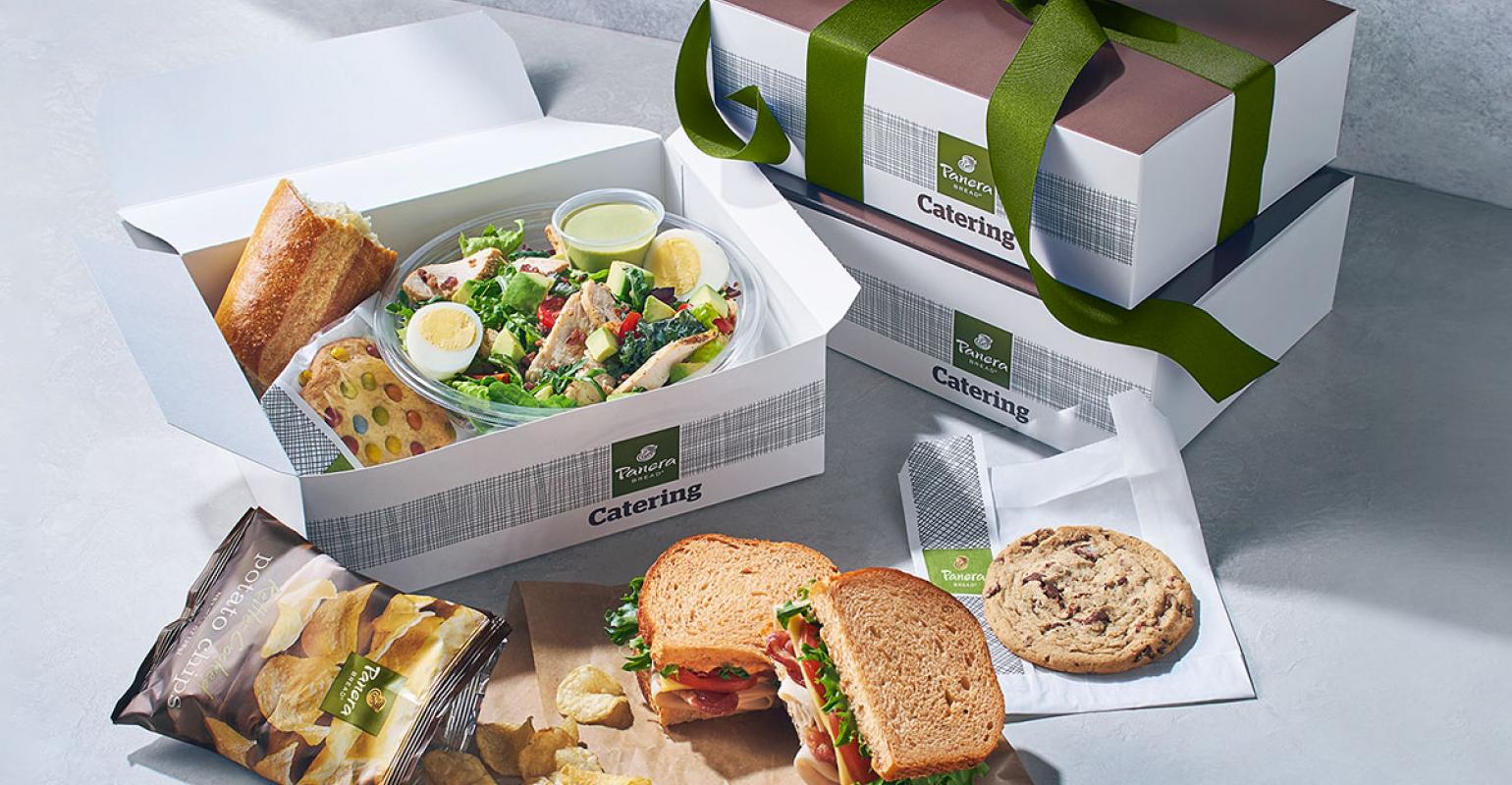
Panera Catering.jpgPanera Bread
Panera Bread closed down their in-house delivery channel without an announcement.
The fast-casual chain has offered in-house delivery for five years but confirmed this week it would switch to third-party-delivery only

Joanna Fantozzi | Apr 15, 2021

Panera Bread confirmed Thursday that they have closed their in-house delivery channel after five years and will now rely on third-party delivery services instead. The change was administered without any fanfare after the St. Louis-based bakery/café chain had previously expanded its delivery capabilities over the years to become one of the largest non-pizza restaurant companies offering in-house delivery.

“Panera continually evaluates our model to put guest preferences at the center of everything we do,” Chris Correnti, senior vice president of off-premise channels at Panera, told Nation’s Restaurant News. “This change enables Panera to offer a broader delivery range to serve increased demand for delivery, in response to an off-premise market that has grown and shifted dramatically over the past year.”

For the first three years of Panera’s delivery experiment, the company relied entirely on its own in-house delivery capabilities and fleet of drivers, expanding the program over the years until by 2018, the Panera app and website offered delivery services in 1,300 locations across 897 cities. At the time, Panera was bucking trends as an outlier as most chains were turning to third-party delivery operators. In 2018, NPD Group warned that the downside to building your own fleet of delivery drivers was dealing with higher labor costs in an industry known for its rapid turnover rates.

In the summer of 2019, Panera began offering third-party delivery for the first time in partnership with DoorDash, GrubHub, and Uber Eats, but clarified that they would maintain their own delivery drivers for quality control and to cut down on third-party delivery commission fees. But now that experiment is now over.

Although Panera did not expand further upon their reasons for giving up on in-house delivery, John Gordon, a restaurant analyst with Pacific Management Consulting Group, said that he would bet it has to do with the staffing crisis:

“For Panera to abandon their vehicles and the capabilities they built in years ago, I can only think they did not want to do this and they are so short on employees that they had to,” Gordon said. “I think they would put [in-house delivery] back in a heartbeat, which may be why there’s no publicity on this: they may want to resume it immediately once labor conditions resume. It’s costing them money to do this.”

Although it’s become increasingly uncommon to find larger restaurant chains that invest in their own in-house delivery rather than fall back on third-party partnerships, Panera is not the only company to invest in their own delivery fleet. Portillo’s Hot Dogs announced plans to roll out an in-house delivery service in 2020, with the intent of creating a hybrid model alongside their third-party partnerships. Portillo’s team handles the largest orders, while their third-party partners fulfill smaller orders.

“[The biggest advantage is that we own the guest experience and that our Portillo’s team members receive tips directly,” Nick Scarpino, senior vice president of marketing and off-premise at Portillo’s, said. “Staffing is our biggest challenge right now, as is with the rest of restaurant industry.”

Panera is not the only chain to about-face in their views on third-party partnerships. Inspire Brands-owned Jimmy John’s has always prided itself on shunning third-party services but that all changed in December 2020, when they announced a third-party partnership for the first time with DoorDash’s self-delivery service. Although Jimmy John’s uses DoorDash’s marketplace and ordering capabilities, they still have their own fleet of drivers.

“We saw very encouraging incrementality. It was hard to ignore,” Jimmy John’s chief marketing officer, Darrin Dugan said of the DoorDash self-delivery pilot test that occurred during the pandemic at stores in Chicago and Austin, Texas.

Economics may well be the driving factor for Panera’s sudden switch too, Jefferies analyst Andy Barish thinks.

“The economics of doing delivery yourself was always somewhat questionable and that has proven itself out over the past several years,” Barish said. “The pizza models are totally different: delivery was always part of their business model. […] it’s an evolving world and it does not surprise me at all that Panera is moving away from self-delivery.”

Contact Joanna at joanna.fantozzi@informa.com

Find her on Twitter: @JoannaFantozzi

Correction: April 16, 2021
CLARIFICATION: We expanded upon an earlier version of this story to clarify that Jimmy John’s does still use their own in-house delivery fleet.

Business Insider – Subway’s ‘dirt-cheap’ startup costs are a huge draw, but franchisees and experts say investing comes with big risks

Apr 14, 2021, 8:01 AM
subway sandwich
Should you buy a Subway location? Experts say to think twice. 
Peter Summers/Getty Images
  • Subway continues to be one of the cheapest restaurant brands to franchise.
  • But declining yearly sales and hundreds of store closures have hurt the company and franchisees.
  • Some franchises tell Insider that operators are trying to unload locations at “dirt-cheap” prices. 

At the peak of its expansion, Subway was one of the hottest restaurant chains to own as a franchise operator. The chain used middlemen known as development agents to rapidly grow across the US. It became the largest chain in America, leapfrogging over industry giants like McDonald’s and Starbucks.

Many Subway operators have amassed dozens of stores, made possible by historically cheap franchise investment costs.

Initial investment costs are $139,550 to $342,400, according to Subway’s 2020 disclosure document. For comparison, Jimmy John’s requires $313,600 to $556,100 in initial investment costs, and McDonald’s costs are $1.3 million to $2.3 million.

But as the distressed sandwich chain lays off hundreds of corporate staff to cut costs amid rumors of a company sale, franchisees and experts say investing in a Subway outfit comes with big risks these days.

That’s prompting some franchisees to consider selling their stores amid improving foot-traffic patterns as the economy slowly emerges from the devastating effects of the coronavirus pandemic.

“Franchisees, in general, are extremely disgruntled,” one current California franchisee said. He and other franchisees were granted anonymity in order to speak frankly about the situation, and their identities are known to Insider.

This franchisee said some operators were unloading stores “dirt cheap” just to get out of leases or ownership.

Subway pushed back on the conclusion that the company does not offer a return on investment for franchisees. In an emailed response to Insider, a representative said that the company pledged $80 million in 2018 toward helping franchisees refresh the brand.

“This includes money spent on a variety of initiatives, ranging from refresh packages for each U.S. restaurant, grants for remodels and supplying them with new equipment for various programs,” the representative said. “We remain laser-focused on our franchisees’ growth and profitability.”

A Subway franchisee from the Midwest told Insider: “Anybody that wants to buy into any kind of restaurant franchise probably needs to have their head examined. I can’t think of a worse category to really look at. With that said, I think there’s actually some real bargains out there in the Subway world right now.”

The bargains come as Subway, along with the rest of the industry, continues to experience a decline in visits, even as business restrictions lift across the US.

Visits to quick-service sandwich restaurants declined by 10% in the year ending in February compared with the same period a year ago, according to the market-research firm NPD Group.

According to Placer.ai, which tracks monthly foot traffic at retail and restaurant chains, Subway traffic declined more than its main rivals over a two-year period. In March, Subway traffic was down 10.1% compared with March 2019, while Jersey Mike’s was down 0.6% and Firehouse Subs was down 4.2%.

Placer.ai data
Placer.ai data shows traffic patterns for Subway, Jersey Mike’s, and Firehouse Subs. 
Placer.ai

Subway’s troubles started long before the pandemic

The 100%-franchised chain has logged declining sales and store counts for years.

Subway’s US sales dropped to $8.3 billion in 2020, down from $10.2 billion in 2019, according to Technomic. The market-research firm’s data indicated 1,796 Subway locations closed in the US last year, with the chain’s store count dropping to 22,005 from 23,801.

For operators, the numbers are more troublesome when compared with yearly sales volumes at rival chains like Firehouse Subs, Jimmy John’s, and Jersey Mike’s.

A Subway restaurant, on average, generates nearly $420,000 in sales annually, according to Nation’s Restaurant News’ “Top 200 Restaurants” report, a highly regarded industry survey. According to NRN’s 2020 report, Subway’s average yearly sales that year were down from $445,400 in 2014 — the year before founder Fred DeLuca died and before the Jared Fogle scandal.

“Sales have gotten so low, lower than they’ve been in a long time,” the California franchisee said. “Inflation keeps going up. And Subway was always on that edge” of profitability, the operator added.

Subway did not return a request for comment.

But the Milford, Connecticut-based company previously told Insider that it strived to “balance what’s best for our guests and our franchise owners as we create compelling offers to drive traffic to Subway restaurants.”

When John Chidsey was named CEO in 2019, the former Burger King executive reached out to high-level operators and “said all the right things,” like being there to help operators make profits, according to a veteran franchisee.

But he has since distanced himself from communicating with franchisees, that franchisee said.

Now frustrated operators want out, the California franchise said.

Five years ago, Subway stores could be worth $300,000 to $400,000, the California operator said. If a franchisee could sell their stores for $100,000 each in 2021, they would be considered lucky, the California franchisee added.

Subway is struggling to keep up with rivals

Subway franchisees say they are struggling to stay afloat as competitors like Firehouse Subs and Jimmy John’s raise their game with menu innovation and better delivery operations. The rival chain Jersey Mike’s gave its franchises $150 million to help finance store remodeling during the pandemic.

By contrast, Subway franchises continue to battle corporate over store hours and foot-long deals.

In June, some Subway franchisees filed complaints with the Federal Trade Commission after the chain rolled out a “$5 footlongs when you buy two” deal, Restaurant Business reported. In the fall, Subway also began strictly enforcing the number of hours a week stores were expected to be open, which infuriating franchisees, the New York Post reported. Until then, the company had allowed flexible work hours and deferred royalties during the pandemic, the Post said.

More recently, sources told Insider that Subway axed a rebate corporate would give franchises to cover extra third-party delivery costs tied to tablets used to field delivery orders. In a memo seen by Insider, Subway told franchisees the company had always intended to “sunset this program once POS integration was completed.”

Subway told Insider the company “supported our franchisees by temporarily offsetting some the program’s initial costs” during the rollout of third-party delivery in 2018.

“As with everything, we take a holistic approach to all factors that touch our franchisees’ businesses with the goal of increasing profitability, including negotiating highly competitive third-party delivery rates,” the company said in a statement sent to Insider. “We continue to invest in programs to help our franchisees grow their business.”

The Subway franchisee from the Midwest said the biggest pain point for franchisees over the past several years had been the company’s deep reliance on discounting, which he said accounted for 60 to 70% of the marketing strategy in 2015.

“Our margins just kept eroding,” the Midwest franchisee said. “When the guest counts weren’t going up, and sales weren’t going up, they just piled on more and more discounts. So 2015, ’16, and ’17 were absolutely the worst years I’ve ever had in this business.”

Experts advise against investing in a Subway franchise

Over the years, Subway operators have been hooked into buying franchises because of the lower startup costs when compared with rival chains, according to 2020 franchise-disclosure documents reviewed by Insider.

When you look at the startup cost and take in the average yearly sales volumes, industry experts and franchisees said now was not the time to invest in Subway, which also charges higher royalty fees than their competitors.

Subway takes an 8% cut of total gross sales, according to its franchise-disclosure statement. Royalties for Firehouse Subs franchisees range from 3 to 6%. And Jimmy John’s takes a 6% cut of gross sales, according to the documents.

Ultimately, Subway franchises are getting hit with a larger royalty fee on declining sales, and they are likely paying the same rent as rival sub shops like Firehouse Subs, the franchise developer Dan Rowe told Insider.

“It’s a terrible franchise now with these volumes,” Rowe, the founder and CEO of Fransmart, said.

Rowe, who helped develop Five Guys coast-to-coast through franchising, said “the point of franchising is to get wealthy, financially independent, and live a great life.”

That’s not happening at Subway, he said, where many franchisees are risking their life savings to invest in a franchise system that is not a good investment.

“It’s quite sad for the franchisees,” he said. “A job is actually better because you aren’t risking your life savings, and you can always quickly quit a job. If you don’t like your Subway, you are stuck until you can sell it, and even then the landlord may keep you on the lease.”

Pacific Management Consulting Group’s John Gordon told Insider that “this is not the time, under any circumstance” to buy a Subway location.

“Find any kind of other brand, particularly one with the drive-thru,” Gordon said. “You need a drive-thru in this post-COVID environment.”

Still, the restaurant consultant Gary Stibel said Subway could still be a very good investment “as long as you’ve got a good location” that is not near rivals, which include convenience stores and premium sandwich shops like Jersey Mike’s.

Stibel, the founder and CEO of the New England Consulting Group, said Subway’s “value proposition has aged but it hasn’t staled.”

If a new owner or current leadership revives the brand, “there is the potential for Subway to come back stronger than it ever was before,” Stibel said.

Wray Executive Search – Restaurant Reality 2021

by John A. Gordon, Principal and Founder, Pacific Management Consulting Group

Our industry depends on people having money and moving around

Economic conditions are moving along nicely right now. After many downs and some ups in the COVID year, both QSR and the sit-down space are moving along—not perfectly in the casual dining/fine dining space, but better. Several things are happening now that are finally showing a broad-based sales lift—not versus 2020 which we know now is a very flawed base, but 2019, which is more realistic. Consider:

  • Economic stimulus payments flowing into the economy.
  • Better weather and “spring fever”.
  • Vaccinations clearly on the rise, reaching critical mass soon.
  • Documented improved consumer confidence in dining out.
  • Tourism and non-business related travel up.

Looking ahead, I’ll be watching for any sales fall off after the $1400 stimulus is spent out, and the typical May-July US restaurant seasonal appear. Also, movie, special event and sporting event attendance, business conventions, and business travel are essential drivers to the wellness of the rest of the industry.

Labor Shortages, Capital Spending, Store Economics: Everything Relates to Everything Else 

With the surge of business underway, operational conditions in many units have gotten difficult. Difficulties have been building for some time, but staffing levels have fallen to be critically short since early this year. Employees leaving such a up and down industry as ours, parents not letting their kids work in restaurants, better unemployment terms than working, and difficult work conditions manning a restaurant shift with so few employees (read that as really hard work) are all taking a toll. Even the New York Times has taken note.[1]

What is vital right now is that restaurant brands and especially franchisors double down on efforts to customize remodel and new unit location specifications to the actual conditions and economic realities that now exist. I note especially “especially franchisors” because the primary company-operated brands can change their capital spending mix more quickly, “on a dime”;  while changing franchisee capital spending plans takes longer.

With this labor shortage and the likelihood of more wage rate driven action because of market or governmental actions, many restaurant brands have taken action to simplify menus and operations within the four walls. At the same time, there is a need for more outside and less inside restaurant space. Sound crazy? Yes, but that is reality. In many markets, guests want to eat outside but the 1970s-1980s footprints didn’t allow for that. This is exactly the time to do the double drive-thrus with reduced seating if you are a QSR; it holds down the CAPEX and staffing at the same time. Yet an international franchisor recently told a client of mine that the program was not available to him for some reason. Petty bureaucratic mess-up?  Perhaps.

Capital efficiency measurements such as sales to investment ratios are critical in our business. Others like simple payback, cash on cash return, and NPV analysis likewise so. More investment monies are lost on missing these metrics than missing several points on food or labor costs. Once the building is built     ( burden 1) and the debt service is locked in (burden 2) it is the most fixed of expenses and really adds up.  Anything to reduce the burden is welcome. In my opinion, a 1 to 1 sales to investment ratio is not good enough anymore with higher construction costs and operating costs, I’d think 1.5X is necessary now.  This is the time to fix store footprints throughout the industry.

Forward Looking

My friends at Restaurant Research noted in their TrafficCast that consumer plans to dine out increased 28.5% year over year [we expected a strong number] over the next 4 weeks, one of the strongest absolute results ever. Hat tip: @RRupdates. However, food at home CPI (basic food inflation) is on an upward march throughout the balance of FY-21, due to proteins. A close watcher of cable TV noted that Burger King earlier banging on a $1.00 menu for some reason, has now reverted to buy one sandwich and get a second for $1.00. The astute restaurant observer @McD_Truth noted BK was the only national brand blasting at such low price points at such a surge in business.

About the author:

John A. Gordon is a long time restaurant veteran with 45 years experience in restaurant operations, financial management corporate staff roles, and management consulting roles. His consultancy, Pacific Management Consulting Group, was founded in 2003 and works complex operations and financial analysis engagements for clients.  He can be reached at 858 874-6626, email jgordon@pacificmanagementconsultinggroup.com.


[1]   As Diners Return, Restaurants Face a New Hurdle: Finding Workers, New York Times, April 8 https://www/nytimes.com/2021/04/08/dining/restaurant-worker-shortage.html?smid=tw-share

Fortune – Can Popeyes threaten KFC’s dominance in China? It’s going to try

BY 


Some 18 months after its chicken sandwich went viral, fast-food chain Popeyes is on a mission to take over the world.

It may not work, of course. Its parent, Restaurant Brands International Inc., has a spotty overseas record, at best. But the ambition alone underscores just how startling a transformation the once-sleepy brand has undergone since the summer of 2019, when the launch of a seemingly ordinary sandwich—a piece of fried meat with pickles and mayo—ignited a frenzy that sparked long lines, sellouts and even fisticuffs all across America.

Whatever the reasons are that it took off like it did—and it’s not clear that anyone truly knows—Restaurant Brands is aggressively seeking to cash in. Popeyes will debut in the U.K. this year, the company is expected to announce this week. That will expand its budding empire to about 30 countries, and Australia is also likely on the docket. Last week, it said a franchise partner would add hundreds of locations in Mexico.

The biggest prize, though, is China, where KFC is a cultural fixture as the country’s largest chain with more than 7,000 locations and three decades of experience. Popeyes opened its first restaurant there in May with a franchise partner and wants to reach 1,500 in a decade, which by itself would boost the chain’s locations by about 50%.

“Customers love chicken in that part of the world,” Restaurant Brands Chief Executive Officer Jose Cil said in a recent interview. “We think there’s a huge opportunity for us by providing an alternative” to “the biggest chicken player in the world.”

The stakes are high for Cil. The company’s other brands, Burger King and Tim Hortons, have tried all kinds of strategies to ignite sales over the past few years and little has worked. Those brands have also struggled in the U.S. during the pandemic. By contrast, Popeyes, which Restaurant Brands acquired in 2017, grew 15% last year.

Popeyes still has plenty of room to expand. Its 3,400 locations worldwide (KFC has seven times as many) generated $556 million in sales last year, just 11% of the company’s total revenue. And only a quarter of those eateries are outside America. Restaurant Brands mostly uses a franchise model that speeds up openings because it relies on finding partners, instead of building a local team. Since the chicken sandwich, Popeyes continues to be inundated by potential franchisees from “across the globe” said Cil, who got the CEO job in January 2019 after running Burger King for four years.

In today’s social-media age, consumer products regularly get caught up in memes and viral moments. Bernie Sanders’s coat, made by Burton Snowboards, grabbed attention at January’s presidential inauguration. Back in 2016, the “Damn, Daniel” craze boosted sales of white loafers from Vans, a brand owned by VF Corp.

But those sales gains were fleeting in many cases. Restaurant Brands is making the bet that the sandwich marks a permanent change in the trajectory of Popeyes. And it’s easy to see why. In the year after the sandwich debuted, the average Popeyes franchise in the U.S. saw sales increase by $400,000 to a total of $1.8 million—almost a 30% gain. That’s well above KFC, but not even half of what the average Chick-fil-A does, according to QSR Magazine, a trade publication. Foot traffic to Popeyes locations jumped by almost half in 2019 and then rose another 29% in the first half of 2020 despite the COVID-19 pandemic, according to Placer.ai.

Then add the chicken boom. Worldwide, people are eating more poultry than ever. Global per capita consumption has increased more than threefold since the mid 1960s, according to the Food and Agriculture Organization of the United Nations.

Looking back, many have credited what has to be one of the world’s most valuable social media posts for starting this. In August 2019, Popeyes debuted the sandwich to rave reviews. About a week later, Chick-fil-A touted its version on Twitter as the original. A simple “y’all good?” reply from Popeyes ignited what the media soon dubbed the “chicken sandwich wars.”

Popeyes locations got quickly overwhelmed, and sold out in two weeks. It restocked, and the frenzy returned. All the while, news stories on those long lines kept America interested for months.

The summer of 2019 proved to be a crossover moment for Popeyes, pushing a brand with a big following in the Black community into new parts of America. The craze birthed stories in no less than the New Yorker and hundreds, if not thousands, of YouTube chefs tried making their own version of the sandwich.

Popeyes, founded in New Orleans in 1972, is taking this unexpected gift and expanding—from the Philippines to Spain. Cil rattled off a list of locales, like South Africa, that he wants to go after next.

Taking on KFC in China won’t be easy. Owner Yum China Holdings Inc., which licenses the brand from U.S.-based Yum! Brands, added 600 KFC locations in the country just last year. Knocking off such an entrenched market leader will take a lot of advertising, according to John Gordon, principal at Pacific Management Consulting Group, a restaurant consultancy.

“It’s always more difficult to come in and take market share away from the incumbent,” Gordon said.

KFC was also the first U.S. fast-food chain to enter China, arriving in 1987, and over the years has loaded its menu with local favorites, like shrimp burgers and congee. It’s evolved into much more of a sit-down experience that many Chinese consumers have viewed as a premium offering.

Sami Siddiqui, president of Popeyes in the Americas, points out that the chain’s debut in Shanghai brought a line of 2,000 people. It’s mostly a digital restaurant with six kiosks. And to cater to local tastes, the company added roasted chicken and more wings to the menu. It also tweaked the sandwich, swapping out breast meat for thighs, which are preferred in China.

“The chicken sandwich changed the game for us,” Siddiqui said in an interview. “We want to take that success to the rest of the world.”

Bloomberg – Lenders Get Stuck With Busted Eateries After Bidders Get Scarce

  • California Pizza Kitchen canceled an auction to sell itself
  • Ruby Tuesday plans to hand over control to its lenders
Customers walk towards the entrance of a Ruby Tuesday restaurant in Bowling Green, Kentucky.

Lenders are having a hard time unloading distressed and bankrupt restaurants, and it’s small wonder. After all, who wants to buy an eatery in the middle of a pandemic when you don’t know whether you can be open or how many people you can seat?

California Pizza Kitchen Inc. on Tuesday canceled an auction to sell itself after no buyers bid for the company, making its bankers the likely new owners. Ruby Tuesday Inc. went bankrupt Wednesday and plans to hand itself over to its lenders. With federal stimulus talks shelved and colder weather putting an end to outdoor dining, the industry’s pain may start to get even worse in the coming months.

“It is a difficult time to sell a casual dining brand,” said John Gordon, a longtime restaurant analyst with Pacific Management Consulting Group. Casual dining chains have been slammed this year both by government shutdowns and by consumer worries about catching Covid-19.

Restaurant dining rooms across the U.S. were temporarily shuttered by the pandemic earlier this year. While most have reopened, capacity limits have put a cap on how much revenue they can actually generate.

“This fear factor is material, it has an impact on the casual dining sales potential,” Gordon said in an interview. He added that locations that can’t reach annual sales of $4 million to $5 million won’t have the margins that entice investors.

Exceptions could be made, however, when a buyer is interested in the troubled chain’s real estate, he said.

‘Great Reckoning’

Casual dining has suffered for the past decade as consumer tastes diverged away from the sit-down experience of chains like Applebee’s and TGI Friday’s. Sales have instead flowed into local restaurants, fast-food chains like McDonald’s Corp., delivery focused companies like Domino’s Pizza Inc. and fast-casual concepts like Chipotle Mexican Grill Inc. and Shake Shack Inc.

“This is now the great reckoning for the casual-dining segment,” said Aaron Allen, chief strategist at restaurant consultancy Aaron Allen & Associates. “Those that are in the distressed asset zone will be going for pennies on the dollar.”

With many diners opting against eating in restaurants since March, casual restaurants have been forced to improvise to hold on to sales. TGI Friday’s, for example, has tried to lure customers with outdoor dining tents, while others are selling meal kits and bulk food.

Uncertainty over the future puts a damper on potential purchases, said Michael Halen, senior restaurant analyst at Bloomberg Intelligence, adding that raising money to buy distressed restaurants is likely tough right now. He said that casual dining traffic has been down in 65 out of the past 66 months, citing data from MillerPulse.

‘Risky Proposition’

“Now if you make a bid, you may lose all of that money. How long can you survive with limited dining room capacity?” said Halen. “A lot of casual dining chains were struggling headed into the pandemic, and now with all the uncertainty around the virus it makes any bid a risky proposition.”

Some larger casual dining chains, like Darden Restaurants Inc. and Bloomin’ Brands Inc., are weathering the storm thanks to sharp management teams and plentiful capital. But that doesn’t mean they’ll be interested in picking up a struggling portfolio of restaurants right now, said Lyle Margolis, a director at Fitch Ratings who focuses on restaurants.