The Street – Buffalo Wild Wings Shares Spike on McGuire’s Director Battle

Buffalo Wild Wings (BWLD – Get Report) shares jumped early Monday after activist investor Marcato Capital’s Mick McGuire escalated his insurgency and announced plans to nominate a minority slate of four dissident director candidates to the wing and beer restaurant company’s nine-person board.

The contest shouldn’t be a surprise as the insurgent fund manager in August sent a letter to Buffalo Wild Wings board urging the company to bring on “fresh talent” to its board and management team.

Marcato has been pushing Buffalo Wild Wings to franchise more of its company-owned stores, fix what it sees as business failures and capital allocation problems, all key parts of the activist playbook when it comes to pushing up the stock prices of public restaurant chain targets.

To drive his campaign McGuire is seeking to nominate himself, Scott Bergren, formerly CEO of YUM! Brands’ Pizza Hut, Sam Rovit, president and CEO of CTI Foods and Lee Sanders, managing director of Rocket Chicks LP.

The fund has a 5.2% equity stake, according to FactSet, and is the fourth largest Buffalo Wild Wings shareholder.

Buffalo Wild Wings share price spiked on the launch of the contest, up roughly 1.5% to $152.15 a share in mid-day trading. Nevertheless, the company’s share price is down from the $165.25 a share it was trading at in August after Marcato issued a critical letter to the company’s board.

McGuire launched his public campaign at Buffalo Wild Wings in July, suggesting that the company should consider strategic alternatives to improve shareholder value and the fund has been escalating his efforts ever since.

Buffalo Wild Wings has taken a few steps in recent months as part of an effort to appease disgruntled investors in an ultimately unsuccessful effort to head off a Marcato contest.  In August, the company announced a $300 million share repurchase authorization, a key tactic of companies targeted by activists. In October, hoping to head off a proxy contest, the restaurant chain installed three new directors, Andre Fernandez, president of CBS RADIO, Hal Lawton, senior vice president of North America at eBay, Inc., and Harmit Singh, executive vice president and chief financial officer of Levi Strauss & Co. McGuire said Monday that the three new directors “don’t go far enough” to address what he sees as a skill deficiency at Buffalo Wild Wings.

Activists often pressure restaurant chains to reduce the number of their company-owned stores by franchising more locations, as part of an effort to raise capital for stock buybacks. This may be a  key goal for Marcato, which has said it wants to see the company move to a predominantly franchised business model. The fund even wrote a letter in December to the company’s franchise owners, noting that based on its approach, franchising will be the top priority and franchisees will receive “equal and immediate” access to new systems, tools and market initiatives.

However, John Gordon, restaurant analyst at Pacific Management Consulting Group, argues that moving to an overly franchised model puts the brand at risk, particularly, with more complicated restaurant chains like Buffalo Wild Wings, which have guest table service and an alcohol component. Gordon notes that Buffalo Wild Wings is currently 51% company-owned and 49% franchisee-owned, with almost no locations outside the U.S.

Marcato chides Buffalo Wild Wings for buying into franchisee units recently at “excessive valuations.” Gordon acknowledges that the company bought some struggling locations from franchisees recently at high multiples. However, he argued that the purchases were made to help improve the company’s overall image and brand and to help revitalize those locations and that they put a spotlight on problems where too much control is ceded to franchise owners.

“You [Marcato] criticizes them for buying back struggling franchise locations and investing a lot of money to bring them back up to par but at the same time recommend that they dump the rest of the company owned stores to other franchisees?” asked Gordon.

He pointed out that Buffalo Wild Wings could receive roughly $1.5 million to $2.2 million per store, depending on each store’s EBITDA, if it were to sell company-owned locations to franchise owners. However, he argued that such spending, which could raise funds in the short-term for stock buybacks, could hurt the overall business and brand over the long term. Gordon suggests that, instead, Buffalo Wild Wings should consider expanding outside the U.S., as means of driving growth.

“Are you making the overall brand and system stronger or weaker?” asked Gordon.

And one of Marcato’s director candidates experience appears to put a spotlight on the franchising goal. Marcato nominee Sanders is described as a “seasoned restaurant and franchise industry executive” who has an “intimate knowledge of the Buffalo Wild Wings franchise system.”

The majority of proxy contests typically settle, with the activist getting one or two director candidate to their target’s board. Nevertheless, it is possible that this proxy contest could go the distance all the way to the annual meeting, which is expected to take place in July.

Marcato has launched 21 campaigns since 2011 but only one director-election proxy contest before this one, according to FactSet. That was at Lear Corp. in 2013 and Marcato’s proxy contest for three of eight board seats was settled for the appointment of one mutually acceptable director and a commitment to hike buybacks. On Thursday, Marcato did reach a deal with Terex Corp. (TEX – Get Report) to add one Marcato recommended nominee to its board. Nevertheless, the lack of a stronger track record when it comes to director election contests suggests that Buffalo Wild Wings might not want to settle early.

The San Diego Union Tribune – Good news for Jack in the Box customers: deeper discounts

In what should be good news for its patrons, Jack in the Box is planning to offer later this year deep discounts on lower priced menu items in the face of growing competition from its fast food rivals.

In an earnings call Wednesday, CEO Lenny Comma said that it has no choice but to start discounting more heavily than has been their practice over the years.

Where the San Diego chain has normally promoted value for budget-conscious customers by offering bundles of sandwiches, fries and soft drinks, it will now start lowering prices on individual menu items, he said.

“I think that you’ll see us pivot to at least some single item promotions in the back half of the year, simply because we’re sort of being dragged into that space by all the competitors, including those that have a higher average check in our space,” Comma said. “Even they are delving into the single item discounts. So I think we’re not going to be able to prevent that from happening.”

He cautioned, though, that Jack in the Box has to be careful to not discount too much and for too long a time or it runs the risk of damaging the brand.

“We don’t want to put ourselves in a position where we simply devalue our brand by essentially turning ourselves in to a perpetual discounter and training the consumer that they should no longer come to us for mid- and top-tier product,” he said. “That’s been our bread and butter over the long term and we will continue to invest there.”

Comma didn’t mention what menu items in particular would be targeted for lower pricing. He noted that recent examples of the company’s more conventional promotional offerings was its Jumbo Meal, which bundled a Jumbo Jack burger with two tacos, fries and a soft drink for $3.99.

The company also is struggling to overcome declining sales at its fast casual chain of Mexican restaurants and is looking at the possibility of unloading the once high-performing Qdoba brand.

Jack in the Box announced this week it has hired the investment banking firm Morgan Stanley to evaluate options for the under-performing Mexican food brand. Although Comma has not specifically stated that spinning off the Qdoba brand is an option being weighed, analysts say it’s clear that is a very real possibility.

“At our investor meeting last May we said that one of the factors that would cause us to reconsider our strategy with respect to Qdoba was valuation,” Comma told analysts during a Wednesday earnings call. “It has become more apparent since then that the overall valuation of the company is being impacted by having two different business models. As a result we have retained Morgan Stanley to assist the board in its evaluation of potential alternatives with respect to Qdoba as well as other ways to enhance shareholder value.”

While Qdoba has a very limited presence in Southern California, including just one outlet in San Diego — at the airport — the brand has grown to 700 locations in 47 states and Canada since Jack in the Box acquired it in 2003.

In recent quarters, it became clearer that Qdoba, once the financial darling of the company, was starting to be a drag on the overall financial performance of Jack in the Box.

During the second quarter ending April 16, same-store sales at Qdoba restaurants fell 3.2 percent, including a decline of 5.9 percent at company-owned locations, a sharp reversal from an overall 2.1 percent gain just a year earlier. By comparison, Jack in the Box same-store sales fell just 0.8 percent during the second quarter.

Looking ahead, company executives are forecasting a 1 percent growth in same-store sales within the Jack in the Box system restaurants but a decrease of as much as 2 percent at Qdoba outlets.

Given the company’s decision to reach out to Morgan Stanley for help, a sale is no doubt one route Jack in the Box could take to address investor concerns, said San Diego restaurant consultant John Gordon.

“Morgan Stanley is strictly an advisory firm that doesn’t make operational recommendations but essentially says if you want to sell it’s worth this and if you want to sell it, we can go out to our network and find a potential buyer,” Gordon said. “There is the potential no one may buy the brand.”

A little less than a year ago, Jack in the Box announced plans to relocate Qdoba offices from the Denver area to San Diego, where it could share space at its parent firm’s Kearny Mesa headquarters. Despite lagging sales, there are plans to open as many as 60 new Qdoba restaurants this fiscal year, the company noted in its current earnings release.

The move to reevaluate Qdoba comes at a time when the bloom is starting to come off the rose of a very successful fast casual market. In the fourth quarter last year, fast-casual chains’ same-store sales fell 1.1 percent on average, according to research by Nation’s Restaurant News.

The New York Post – Fast food sales are growing faster than US economy

By Lisa Fickenscher

The burger is baaack.

For the first time in five quarters, the big three fast food giants — McDonald’s, Burger King and Wendy’s — posted same-store sales increases of greater than 3 percent.

Put another way, burger sales are growing faster than the US economy, which rose by a meager 2.6 percent in the second quarter.

The GDP in the US hasn’t produced an annual uptick of 3 percent or greater in the last 10 years.

The burger chains are producing strong results because diners are eating at fast food joints more than at other restaurants, say industry experts.

“When people spend less at higher-priced restaurants and more at fast food, it means that they are spending their money more cautiously,” said Nomura Instinet analyst Mark Kalinowski, adding that “on the whole, the restaurant industry is going through hard times.”

Wendy’s said on Wednesday that its same-store sales rose by 3.2 percent in the second quarter compared with a 0.6 percent bump a year ago.

McDonald’s and Burger King both posted same-store sales in the US of 3.9 percent in the most recent quarter. A year ago, Burger King’s same-store sales rose by just 0.6 percent.

“Usually, when one of the big three gets stronger, the other two get a little weaker, but what’s unusual now is that they all grew together and they all had positive foot traffic,” said John Gordon, principal of Pacific Management Consulting Group.

Diners were lured by value meal promotions like McDonald’s McPick 2 for $5 menu and Wendy’s 4 for $4 Meals, said Kalinowski.

Americans’ love affair with burgers doesn’t apply to everyone.

Shake Shack, which sells premium-priced burgers, took a hit in the most recent quarter as it raised prices, driving away customers.

Same-store Shake Shack sales dipped 1.8 percent, compared with 4.3 percent growth a year ago, the company said last week.

The New York Post – Chain restaurants struggle to attract CEOs

By Lisa Fickenscher

 Chain restaurants struggle to attract CEOs

As casual restaurant chains like Applebee’s and Ruby Tuesday see traffic erode, their C-Suites are looking as empty as their parking lots.

Five national chains, which operate about 6,300 restaurants, are rudderless — without a CEO as the board has let go its former boss but can’t recruit a new leader.

The latest CEO exit came Friday when DineEquity — which runs Applebee’s Neighborhood Grill & Bar and IHOP — said longtime Chief Executive Julia Stewart resigned.

Stewart, a former waitress at the pancake chain who worked her way up to the corner office, stepped down amid a steep decline in the company’s financial performance.

Same-store sales at the company’s 3,700 restaurants declined 5 percent last year, and its stock plummeted 9.6 percent Friday, to $60.14 on the news of the 16-year veteran’s departure.

DineEquity will begin a CEO search but will have lots of company looking for talent.

Ruby Tuesday, Papa Murphy’s, Fiesta Restaurant Group and Noodles & Co., which this week announced the closure of 55 locations, are each searching for a permanent CEO.

All but Papa Murphy’s have been rudderless since last year.

The problem facing many CEOs of casual family restaurant chains is that their concept is getting old and the menu no longer resonates with diners, industry experts say.

Ruby Tuesdays, founded in 1972, has never been worse off.

“The desperation in that dining space is getting deeper and deeper,” said John Gordon, principal of Pacific Management Consulting Group. “The problem is who do you get to go into these troubled companies.”

Bob Gershberg, CEO of Wray Executive Search, said the casual chains “just doesn’t appeal to the millennial consumer. They have zero interest in sitting down for 90 minutes to get mediocre food.”

Colorado-based Noodles’ problem was that it grew too fast after its 2013 IPO.

The pain in the casual segment extends beyond those without leadership: Ignite Restaurant Group, which operates about 130 Joe’s Crab Shack’s and Brick House Tavern & Tap eateries, is fighting to have its stock not get delisted; Bloomin’ Brands, which owns Outback Steakhouse and other brands, on Friday closed 43 underperforming restaurants.

“You can walk into an Outback today and it looks nearly the same as it did in the 1980s,” when it was founded, Gordon said.

Some Applebee’s franchisees are hopeful that the CEO turnover at DineEquity will shake up the status quo.

It was a “great move toward Applebee’s march back to profitability in a difficult market,” said Zane Tankel, who runs 39 Applebee’s in the New York metro area.

Nation’s Restaurant News – The 6 worst restaurant deals of all time

Jonathan Maze 1 | Jan 18, 2017

Blog: Overaggressive deals lead to disaster

This post is part of the On the Margin blog.

The restaurant industry is a difficult one. The country is saturated with restaurants. Consumers are fickle. It cost a lot of money to build units, which often results in heavy indebtedness and questionable financial deals.

Add to this the pressure on company executives to expand, and you have a recipe for disaster when it comes to acquisitions.

The past 15 years have seen a lot of very bad restaurant deals — so much so, that we struggled to limit this list to just five, gave up and listed six.

We focused on larger deals, because smaller investments are inherently riskier and thus some problems can be expected. And some people might perceive a deal to be a bad one, when it really isn’t — you’d be shocked, for instance, how much money a private-equity group can make off of a seemingly bad restaurant deal.

Now for the big deals.

Jonathan Maze, Nation’s Restaurant News senior financial editor, does not directly own stock or interest in a restaurant company.

Contact Jonathan Maze at jonathan.maze@penton.com

Follow him on Twitter: @jonathanmaze

The Dallas Business Journal – Pollo Tropical closing 30 more stores; parent company plans brand relaunch

By   –  Digital editor, Dallas Business Journal

The parent company of Taco Cabana and Pollo Tropical is shuttering 30 company-owned restaurants as it prepares to “relaunch” both brands.

Fiesta Restaurant Group (Nasdaq: FRGI) announced Monday that it plans to close 30 Pollo Tropical restaurants in North Texas, Austin and Nashville. The closures will happen Monday, and where possible, impacted employees will be offered jobs at nearby Fiesta restaurants.

Five of the locations in Texas could be rebranded as Taco Cabana units. With the closures, Fiesta will own 19 Pollo Tropicals outside of Florida, including 13 in Atlanta and six in South Texas.

“(These restaurants will be used) to apply and prove successful regional strategies for future Pollo Tropical expansion beyond Florida,” Fiesta said in a prepared statement.

Closing the restaurants is expected to incur non-cash impairment charges between $33 million and $37 million during the first quarter, and another $9 million to $12 million in lease and other charges during the second quarter.

“Fiesta’s recent growth initiatives diverted resources from our core markets and some amount of renewal is required to restore momentum in these markets,” Fiesta’s president and CEO Richard Stockinger said in a prepared statement. “While the decision to close restaurants is never easy, we believe it is vital to focus the company’s resources and efforts on markets and locations that have proven successful for our brands.”

This isn’t Pollo Tropical’s first round of closures in the past year. In November, the brand announced plans to shutter 10 units in Texas, Georgia and Tennessee,expecting to incur total charges between $20 million and $24 million.

As a result, the company’s stock tumbled, and Craig Weichmann, founder of Fort Worth-based Weichmann & Associates, an investment banking consultancy specializing in restaurants, said Fiesta had landed itself in what he terms Wall Street’s “penalty box.” He predicted it would be a hard slog for the company to regain investor confidence and share price.

“They set the bar too high, so Wall Street came back with a resounding selling off of the stock,” Weichmann added. “It takes a long time of getting back to the basics of performance, performance, performance before Wall Street will trust you again.”

Shares of opened at $22.90 on Monday, down more than 34 percent over the past 12 months.

John Gordon, principal and founder of restaurant consulting firm Pacific Management Consulting Group , attributed Pollo’s latest round of closings to overexpansion and misaligning with customers’ tastes.

“Pollo’s challenge in DFW isn’t confined to just that brand,” Gordon said. “DFW has become the chain restaurant headquarters focal point in the U.S., and DFW is a major US market for chains moving either west or east. As a result, too many restaurants, especially fast casual brands have been built over the last ten years, and the demand is simply spread around too many stores, making the store sales levels too low.”

“In addition, restaurants that have a unique flavor profile like Pollo that work in some home markets have to be carefully introduced to new, expansion markets,” he added. “While the U.S. is becoming more diverse culturally, consumer’s buying circles and economic activity tend to cluster in influence groups. It is really important for restaurants to tap into the right clusters from a site selection standpoint.”

But the company also announced Monday a “renewal plan” it says will aim to drive long-term value for both concepts. Among its initiatives will be relaunching the Pollo Tropical brand in September and the Taco Cabana brand later in the year.

The relaunches will include differentiating the brands with new positioning, marketing and digital strategies; improving catering, delivery and online ordering capabilities; enhancing food quality and service; repositioning each brand for future growth outside core markets; and refining restaurant prototypes to maximize cash returns and appeal to more customers.

Also in the plan are initiatives like implementing operational efficiencies and digital platforms, looking at pricing across Fiesta’s restaurant portfolio and curtailing new restaurant development until after the relaunch.

“Our strategic renewal plan is based on our comprehensive review of all aspects of our business to improve the guest experience and drive our results,” Stockinger added. “We are … concentrating on being a leader in comp store transaction growth and margins, growing intelligently both organically and through other avenues while enhancing shareholder value.”

In its Monday announcement, Fiesta reported comparable restaurant sales declined 6.7 percent at Pollo Tropical and 4.5 percent at Taco Cabana during first quarter 2017. The company blamed industrywide headwinds and sales cannibalization.

Full first quarter results will be released May 8, with a conference call at 3:30 p.m.

News of Fiesta’s renewal plan comes after the company has been urged to look at options to increase value. In February, concerned by Fiesta’s “massive decline in value,” activist investor JCP Investment Management nominated three candidates to shake up the company’s board of directors.

At the time, JCP, which owns 8.7 percent of Fiesta stock and is its third-largest institutional shareholder, said the company “refused to engage meaningfully” on the composition of its board and other corporate governance matters, adding that Fiesta’s current board has minimal ownership int he company and little restaurant experience.

 JCP strongly believes that the board must be reconstituted with direct stockholder representatives and experienced restaurant operators,” the firm stated in documents filed with the U.S. Securities and Exchange Commission. “JCP’s director candidates collectively bring not only significant operating experience in the restaurant industry, but a strong track record of creating shareholder value.”

JCP has also criticized the board for allocating $70 million to expand Pollo Tropical in Texas, an effort that was suspended in September.

And the firm said Fiesta has failed to recognize, or at least capitalize on, the value of Taco Cabana. In September, Fiesta scrapped plans to spin off Taco Cabana into its own publicly-traded company.

Since then, Fiesta has added Paul Twohig to its board. Twohig, who joined in February, currently serves as president of Dunkin’ Donuts U.S. and Canada, and has experience at Starbucks and Panera Bread.

The company has also said it will consider adding one of JCP’s board candidates and another member to be chosen by the board at a later date.

However, JCP continues to push for the addition of two “highly-qualified director candidates,” it said in a letter to the board.

“W e believe adding such individuals to the board would remedy the board’s apparent lack of restaurant expertise and avoid a seemingly unnecessary election contest, which we believe could only benefit the entrenched directors who we do not believe belong on the board,” the letter states.

Fiesta declined to give further comment and said it would provide additional details in its quarterly earnings call.

The Columbus Dispatch – Bob Evans sells restaurants; food division buys potato company

Like one of its iconic biscuits, Bob Evans Farms has been split in two.

The New Albany-based company sold its restaurant division, which runs 523 stores in 18 states, to private equity firm Golden Gate Capital for $565 million. Bob Evans Farms’ packaged foods division, which makes mashed potatoes, sausage and other side dishes, will continue as a stand-alone, publicly traded company.

Both companies will remain in New Albany at the recently built headquarters, where 400 work.

“This is really a great day,” said Saed Mohseni, Bob Evans CEO, who will remain chief executive of the restaurant company. “We have had a lot of conversations. We looked at many, many options. The conclusion was that both businesses were better off (split up) due to where they are in their life cycle.”

The restaurants continue to see a drop in sales as a slide in customer traffic and profitability has plagued the chain — and many like it in the causal dining segment — for years. The food division is on a different path, though. Bob Evans’ refrigerated side dishes, sold in grocery stores, are the national market leader, and double-digit sales growth has been the norm of late.

Analysts have speculated about Bob Evans’ two divisions for a long time, with many believing the company would sell or spin off the packaged foods to focus on the restaurants.

“It is not the way it was expected to go,” said John Gordon, principal of the Pacific Management Consulting Group. “I would have thought the easiest route was to sell (the food division), but the restaurants were so devalued because of general problems of casual dining that they got swallowed instead.”

The switch to private ownership might give Bob Evans restaurants time to heal and find a way forward, Gordon said. Mohseni agreed.

“Private is much better than being public right now and having to live through quarter after quarter,” Mohseni said. “We can make longer-term decisions instead of looking at every 12 weeks.”

For instance, on March 4, 2015, investors whacked 22 percent off the value of Bob Evans’ stock after a poor quarterly earnings report. The stock has been almost stagnant since.

Mohseni does not believe there will be layoffs or mass store closings in the wake of the deal. Bob Evans has closed dozens of stores in the past year or so and lopped millions from its budget through cost-cutting the past few years. There might even be some hiring, Mohseni said. As part of the restaurant-sale news, Bob Evans also announced the purchase of Pineland Farms Potato Co., based in Maine.

Pineland Farms was a supplier to Bob Evans, and it helped to meet demand for its side dishes on the East Coast. The purchase will help the company grow in Northeast markets such as Boston and New York, Mohseni said. Pineland also comes with a 900-acre farm. Bob Evans Farms will continue management of its farm property in Gallia County.

Golden Gate Capital is based in San Francisco and has some restaurant history. The firm owns Red Lobster and California Pizza Kitchen. It also once owned Romano’s Macaroni Grill. Golden Gate’s record, however, is spotty, Gordon said.

“They are a collector of restaurant brands,” Gordon said. “They bought Macaroni Grill and it just totally hit the pavement right after that.”

While Mohseni follows Bob Evans restaurants to Golden Gate, Bob Evans Farms will be led by a new chief executive, Mike Townsley, who is currently president of the food division. Townsley has been with Bob Evans since 2003.

The proceeds of the sale of the restaurants will be at least $475 million and will be used to pay down debt and issue a special dividend of $7.50 for every share of stock. Activist investor Thomas Sandell, who holds about 8 percent of Bob Evans shares, will receive more than $12 million with the special dividend. Sandell lobbied the company for more than two years to sell its real estate, cut costs and find a way to split up the company for maximum value.

Sandell was not available for comment.

Mohseni said the two companies will continue to work closely given that each is integral to the other. The food division sells sausage and mashed potatoes to the restaurants. The split isn’t unprecedented, though history has not been kind to restaurants in such deals, Gordon said.

“There is precedent,” he said. “Stouffers ran a restaurant chain once.”

jmalone@dispatch.com

@j_d_malone

The Chicago Tribune – Judge says blind man can sue McDonald’s over drive-thru-only ordering

Ally MarottiContact Reporter  Chicago Tribune

To the many who succumb to late-night cravings, McDonald’s drive-thru can be a beacon of fast-food hope. But without a car, the dreams of indulging in that burger desire are dashed.

A blind man from Louisiana wants the fast-food giant to come up with another solution for those who physically can’t drive through a drive-thru.

Scott Magee, who is blind, filed a lawsuit in May alleging that only offering service to customers in cars at drive-thru windows when the interior of the store is closed is a violation of the Americans with Disabilities Act. A federal judge in Chicago ruled Wednesday that despite McDonald’s attempts to have the case dismissed, Magee can go forward with the suit, which seeks class-action status.

“Most Americans have the experience of driving through a drive-thru and ordering for themselves,” said Roberto Luis Costales, the New Orleans-based lawyer representing Magee in the case. “That’s an experience Mr. Magee doesn’t have.”

Many McDonald’s locations operate only as drive-thrus late at night as a security measure. The suit says that cuts off service to disabled customers, like Magee, who don’t drive.

The suit isn’t asking McDonald’s to allow people to start walking through drive-thrus. That’s unsafe, said Costales, who also has an office in Chicago. It asks the fast-food chain to find some other way to serve customers without cars when only the drive-thru is open.

McDonald’s representatives did not respond to requests for comment, and attorneys representing the company declined to comment.

A possible solution, Costales said, would be allowing people to order ahead and have an employee bring the food out to them. McDonald’s could do that with its app, he said.

The company, which is planning to move its headquarters from suburban Oak Brook to Chicago’s West Town neighborhood, rolled out a mobile app in 2015 and is expected to launch a mobile order-and-pay function sometime this year.

But McDonald’s has been behind on its app compared with a slew of fast-food competitors. Taco Bell launched a mobile order-and-pay option in 2014. Kentucky Fried Chicken and Chick-fil-A announced mobile-pay apps last summer.

“From a corporate standpoint, they are the ultimate battleship that just takes forever to turn,” said John A. Gordon, founding principal of San Diego-based chain restaurant consultant Pacific Management Consulting Group.

McDonald’s is working on it, but it works with thousands of franchisees, and there are logistics to contend with surrounding mobile order-and-pay options, among other issues, Gordon said.

In the complaint, filed in U.S. District Court in Chicago, Magee called out a McDonald’s near his home in Metairie, La., as well as two locations he visited in San Francisco and Oakland, Calif.

The court ruled Wednesday that Magee had standing under the Americans with Disabilities Act to sue regarding the Louisiana restaurant since he is likely to visit again. It also ruled that he could seek damages related to the two other locations under a California law.

amarotti@chicagotribune.com

Twitter @AllyMarotti

Bloomberg – Mom-and-Pop Joints Are Trouncing America’s Big Restaurant Chains

Americans are rejecting the consistency of national restaurant chains after decades of dominance in favor of the authenticity of locally owned eateries, with their daily specials and Mom’s watercolors decorating the walls.

It’s a turning point in the history of American restaurants, according to Darren Tristano, chief insights officer at Chicago-based restaurant research firm Technomic.

“This really seems to be the dawning of the era of the independent,” Tristano said. “The independents and small chains are now outperforming. The big chains are now lagging.”

Free-marketing websites, such as Yelp Inc., have boosted the fortunes of independents in the age of McDonald’s, Cracker Barrel, Domino’s, Taco Bell, Olive Garden — the list goes on. In a shift, annual revenue for independents will grow about 5 percent through 2020, while the growth for chains will be about 3 percent, according to Pentallect Inc., an industry researcher in Chicago. Sales at the top 500 U.S. chains rose 3.6 percent last year. The gains were larger, 3.9 percent, for the whole industry, Technomic data show.

Closing Locations

Large chains seem rooted in the American experience. But times, and tastes, are changing. Customers these days believe locals have better food, service, deals and even decor, the Pentallect report said.

Sales are reflecting that. Last year, revenue was up 20 percent at DineAmic Group in Chicago, which owns nine different restaurants.

Honors System

Donna Lee

Source: Brown Bag Seafood

At Chicago’s Brown Bag Seafood Co., where sales jumped 63 percent in 2016, lunch customers can grab a cookie out of the “honors system” mailbox for just $1. There are homey touches, like a watercolor painting of the Clark Street Beach in nearby Evanston, Illinois, that founder Donna Lee’s mother painted.

Lee started Brown Bag in 2014 after realizing chains didn’t do it for her. “It feels like you’re there only and solely to get your food quickly and get out the door,” she said. “There really is no charm.”

Daily-Catch powerbox

Source: Brown Bag Seafood

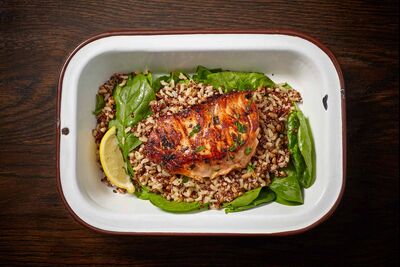
Brown Bag’s top seller is its daily-catch powerbox with grilled fish — barramundi was on the menu on a recent weekday — served atop quinoa, wild rice and spinach for $9.99. A nearby Panera Bread Co., which has more than 2,000 locations in 46 states and Canada, charges the same price for a strawberry poppyseed salad with chicken.

Some chains are trying to imitate the success of smaller, independent brands. At Maggiano’s Little Italy, which has 52 locations and is owned by Chili’s parent Brinker International Inc., traffic has been on the wane. Same-store salesdropped 1.6 percent in the most recent quarter for the fourth-straight decline.

Maggiano’s has new menu items and meals that cater to customers’ allergies and diets — think vegetarian, vegan and the occasional gluten-free ravioli. The chain updated its menu to include executive chef photos and short bios, and in February it introduced an emblem of millennial hip: brunch.

“The experience of dining out has become much more important than it was before,” said Larry Konecny, chief concept officer.

Bullish on Mom

Restaurant suppliers also have noted the trend. Diners prefer the experience, service and value offered by independent restaurants, Pietro Satriano, chief executive officer of US Foods Holding Corp., said during a conference call this month. “Growth with independents was very solid” in the latest quarter, he said.

While national chains advertise like crazy, mom and pops depend mostly on word of mouth and Yelp reviews.

“It’s not the same barriers to entry that there were, that if you put up this group of restaurants that you have to have this big TV campaign. No, you don’t,” said John Gordon, restaurant and franchisee consultant at Pacific Management Consulting Group in San Diego.

It’s “authentic” and Instagram-able experiences that diners are searching for these days, Gordon said. “It’s not experiential to sit in a rundown McDonald’s.”

Wray Executive Search – A Deeper View of Current Restaurant Conditions, from the Finance and Development Conference

By John A. Gordon, principal and founder of Pacific Management Consulting Group

I had the opportunity to attend the 26th annual Restaurant Finance and Development Conference last week. This is an excellent conference to get beyond the headlines and spin from earnings calls. Here are a few observations of themes heard: Read more

Wray Executive Search – Reading Restaurant Results Properly

By John A. Gordon, principal and founder of Pacific Management Consulting Group

Many of you know I’ve been working complex restaurant analytical roles and engagements since the early 1980s. I’ve seen over that time, advances in restaurant management systems, technology and data gathering has expanded exponentially. Restaurants today of course are complex blend of people, brand building and management systems bundled together; the outgrowth of this is numbers have become incredibly important. Read more

The Union Tribune – Qdoba fast casual brand moving to San Diego

By Lori Weisberg • Contact Reporter
JULY 18, 2016, 6:04 PM

Jack in the Box’s fast-casual brand, Qdoba Mexican Eats, is relocating its offices from the Denver area to San Diego, where it will begin sharing space early next year at its parent firm’s Kearny Mesa headquarters.

The move comes with a bonus: 50 new hires and a gradual rollout of Qdoba eateries in San Diego, potentially setting the stage for a rivalry with competitor Chipotle Mexican Grill.

While Jack in the Box is based in San Diego and has numerous fast-food outlets here, Qdoba didn’t have a presence in the county until it recently opened a location at San Diego International Airport.

Jack in the Box acquired Qdoba more than a decade ago but the subsidiary remained headquartered in Denver. Now, it sees the financial wisdom of sharing resources, said Keith Guilbault, the brand president.

Qdoba expects to open new restaurants in San Diego but isn’t ready to say exactly how many, although the first ones would be ready
by next year, the company says. (Courtesy of Qdoba) “The brands grew up separately, but over the years, we started to share resources in functions that make sense like IT, accounting, legal, some of the support services,” he said. “So as we looked for efficiencies, we took a hard look at it and realize there were some of these efficiencies and made the decision over a month
ago to move.”

Guilbault said the company will be scouting for new restaurant locations throughout the county, with the goal of opening some by next year. There are six Qdoba outlets in the Los Angeles area.

“We believe there is room for more fast-casual Mexican,” Guilbault said. “We pride ourselves on coming into the market as a different fast-casual Mexican chain. We have great variety. We don’t nickel and dime our
guests when they add on things like guacamole or queso, which we’ve seen was a frustration with people at other chains. Our restaurants are definitely designed as a place where people can come in and have a great meal with comfortable seating, as opposed to getting people in and out.”

San Diego restaurant consultant John Gordon is surprised that the chain’s relocation to San Diego didn’t happen earlier. The sharing of resources, he said, makes financial sense and opening some Qdoba restaurants here could serve as a convenient proving ground for future store and menu development.

The expected expansion effort comes three years after Qdoba moved to close more than 60 stores in ill-performing locations.

“Qdoba is more important to Jack in the Box now because they’ve identified it as their major growth brand and they want it in a place where they can watch it,” Gordon said. “Qdoba closed stores, made some menu changes and brought in a new CEO, so it’s been on a recovery road ever since.

“And Qdoba will be a direct competitor with Chipotle, whose market share and sales are down.”

Roughly half of Qdoba’s 95 corporate-level employees will remain with the company as it relocates, although some will work remotely, Guilbault said. The remainder either are in positions that are being eliminated or
they opted not to move to San Diego, he said.

The chain has more than 650 restaurants in 47 states, the District of Columbia and Canada.

lori.weisberg@sduniontribune.com (619) 293-2251 Twitter: @loriweisberg
Copyright © 2016, The San Diego Union-Tribune

The Street – Chipotle Is the First, but Not the Last, in Coming Wave of Restaurant Activism

An activist investor could pressure any of these struggling restaurant
chains into the hands of Yum! Brands.
BY RONALD OROL
Nov 12, 2016 11:40 AM EST
Editors’ pick: Originally published Nov. 7.

Could an activist hedge fund drive Dunkin’ Brands (DNKN – Get Report) to put itself on the market?

At least one analyst following the fast-food donut and restaurant chain believes the answer is yes. John Gordon, restaurant analyst at Pacific Management Consulting, suggests that an activist at Dunkin’ Brands could agitate for a sale of the chain, and that Yum! Brands (YUM – Get Report) might be a possible buyer now that it has completed the separation of its China business. Yum!, the company behind Taco Bell, Kentucky Fried Chicken and Pizza Hut, completed the spinoff of its China unit on
Nov. 1.

For Gordon, a Yum! acquisition of Dunkin’ Brands would help boost the donut company’s international growth. Yum! is already subject to an activist that is likely looking for more growth-oriented deal-making. And the restaurant chain has the infrastructure and expertise in place to help Dunkin’ Brands expand its franchised model successfully.

“Dunkin’ Brands hasn’t been successful internationally,” Gordon said. “Yum! would have the international infrastructure and business development expertise in place so it could slide Dunkin’ Brands into its existing organization.”

Dunkin’ Brands currently has roughly 5,000 Baskin-Robbins and 3,000 Dunkin’ Donuts locations outside of the U.S., which, as a group, haven’t performed well lately, posting negative same-store sales for the past three quarters. Gordon noted that it opened 11 Dunkin’ Donuts International locations in the third quarter, a low number signaling weakness.

Would Yum! be interested in making a major acquisition? It’s a serious possibility. Yum! CFO David Gibbs told an investor conference on Oct. 11 that if there were an acquisition that the Louisville, Ky., company could make to “accelerate” its growth, it would “certainly be considered.”

In addition, Greg Creed, Yum! CEO, told investors that the company has enough cash to pursue an acquisition despite its commitment to return $13.5 billion to shareholders between 2015 and 2019 in stock buybacks and dividend distributions. “If an opportunity arose, we’ve got plenty of liquidity and we’ve got plenty of cash to take advantage of it,” Creed said at the conference.

In fact, Yum! had about $2.9 billion in cash as of September, up from $861 million in the same period last year, according to its October quarterly report. “The cash amount is way up, fueling the speculation that something could be done with it before it is dividended out or used to reduce debt,” Gordon said.

Sharon Zackfia, restaurant analyst at William Blair, said that one positive aspect to a Yum!-Dunkin’ Brands combination would be that there isn’t much overlap when it comes to each company’s businesses. “They are both franchised concepts and there would be little cannibalization of Dunkin’ by Yum!’s KFC or Taco Bell,” Zackfia said.

However, she noted that it would be easier to accelerate Dunkin’ Brands’
international operations if the company could improve its existing franchised locations first.

Alternatively, an activist could agitate to have Yum! acquire Subway, which is privately held and has over 44,000 locations inside the U.S. and outside. The sandwich retailer’s co-founder, Fred DeLuca, passed away last year, leaving DeLuca’s sister, Suzanne Greco, in charge. Gordon contends that Subway could be a target for acquisition in the months to come.

“The trouble with Subway is they overdeveloped stores in the U.S. and DeLuca’s sister is running the place and she doesn’t have the brand transformational skills,” Gordon said.

In response, a subway spokesman said that Greco grew up in the business and has served in many different roles, including sandwich artist and R&D, and is “leading the evolution of Subway.” In addition, he added that Subway owners have “consistently said the brand is not for sale.”

Corvex Management’s Keith Meister, a protégé of Carl Icahn, has been agitating at Yum! for some time. Meister initially pushed for a separation of the China business, and in 2015, Yum! added the activist manager to its board just as it said a decision was imminent on a strategic review it was working on. The insurgent manager owned 21 million shares, with a $1.7 billion value, as of its most recent positions filing in August. Meister, who is still on the board, could push for Yum! to acquire Dunkin’ Brands, Subway or other fast-food chains to drive growth.

However, Zackfia said she was skeptical that Yum! would be interested in buying Subway, partly because with its numerous locations in the U.S. and abroad it may be too far along on the maturity curve for the KFC, Taco Bell and Pizza Hut owner. “Yum! would likely want something younger that they can grow,” she said.

Another fast-food company that could become an M&A target in the months to come is Chipotle Mexican Grill (CMG – Get Report) . The burrito chain is under pressure from activist investor Bill Ackman’s Pershing Square Capital Management, which has a 9% stake.

One activist fund manager, who requested anonymity, told The Deal that he believed that Ackman could try to force a merger between Restaurant Brands International (QSR – Get Report) , which owns Burger King and Tim Hortons, and Chipotle. In addition to Ackman’s large Chipotle stake, the embattled insurgent fund has a 17% stake in Restaurant Brands and could be trying to drive growth at QSR and reap a premium on his investment in Chipotle.

In addition, a large swath of Chipotle’s shareholders aren’t happy with the company’s performance and executive compensation, including CtW Investment Fund, an organization that advises pensions for unions that is seeking to have the company replace one of its co-founders with an independent director.

Feeling the heat, the burrito chain responded last month with a dizzying array of new initiatives targeted at igniting growth at the same time that it posted a disastrous third quarter.

How would a deal work?

It is extremely unlikely that Restaurant Brands International will be a candidate for an activist-pressured takeover anytime soon. Private equity firm 3G Capital, co-founded by Alexandre Behring, controls Restaurant Brands International’s exchangeable units that convert into about 43% of the voting interest in the company, a major impediment to any dissident-director election effort.

But a Restaurant Brands acquisition of Chipotle would have problems as well. Gordon notes that QSR has accumulated a substantial amount of debt when it was formed to combine Burger King and Tim Hortons in 2014, and as a result it is likely to spend the next few years on developing its existing brands.

Instead of a deal, Ackman could pressure the burrito chain to shift its company owned model into a franchised approach in a move that could drive a hike in capital distributions to shareholders. The idea is simply to sell company-owned stores to their operators or other interested parties to raise cash. Chipotle currently does not franchise and would have to establish the appropriate infrastructure, which includes setting up operational support systems, training and setting up of franchise advisory councils, as well as construction assistance.

However, Zackfia noted that an activist wouldn’t need to push Chipotle into
franchising to raise cash for a hike in its capital distribution plan. “They have no existing debt so they wouldn’t have to do franchising to raise [capital] to repurchase more shares,” Zackfia said.

In addition, it would take significant time for Chipotle to shift to a franchising model, domestically, internationally or both. “There are systems and infrastructure that need to be set up to do franchising. It would take at least 12 months to do it,” Zackfia said.

Still, Ackman could also be privately pressuring Chipotle to expand globally, beyond its 20 or so non-U.S. company-owned locations. Whether driven privately by Ackman or not, the burrito chain appears to be looking to do just that. It recently brought in a new managing director for its European business, Jim Slater, who previously worked at Costa Coffee. Chipotle co-CEO Montgomery Moran told analysts last month that
“expanding … in Europe holds a lot of promise” for the chain’s future.

EDITOR’S NOTE: This article was originally published by The Deal, a sister
publication of TheStreet that offers sophisticated insight and analysis on all types of deals, from inception to integration.

©1996-2018 TheStreet, Inc. All rights reserved.Action Alerts PLUS is a registered trademark of TheStreet, Inc.

Restaurant Finance Monitor – What Happened at Cosi?

Published: 

From a high stock price of $43 in 2006 to bankrupt and delisted, Cosi is a tough lesson in high rents and disorganized management for fast-casual restaurants.

When Cosi first emerged in the U.S. in 1996, it was among a handful of fast-casual pioneers that relied on three day parts, but unlike other pioneers the company never made much money.

It peaked at 151 units in 2008, but had been struggling to reach AUVs high enough to cover the high cost of rent through the Great Recession. According to a 10-K, rent occupancy costs (which do include paper goods and packaging) sat at 30.1% of sales in 2008. And even as the company closed locations that number continued to rise, reaching a staggering 37% at company locations in 2014 as rents rose and sales slowed.

Unlike fast-casual peer Panera, Cosi over-extended in markets with expensive rent. And the strategy of favoring business centers meant a busy coffee and lunch rush, but a dismally slow dinner hour when business crowds went home. And even the breakfast rush slowed as so many concepts jumped on the day part with high-quality coffee and breakfast fare.

“They were really outclassed at breakfast by everything that has happened in the space,” said restaurant analyst and consultant John Gordon, with Pacific Management Consulting Group.

He said without money to fund strong marketing behind the concept, things only got worse.

“If you’re not promoting with an organized marketing program with some kind of LTO base, maybe at a discount, that is what happens,” said Gordon. “You can’t really do 7% marketing when your rent is 25% of sales.”

According to an analyst report from Anton Brenner at Roth Capital Partners in January of 2016, rent alone averaged out to 21.1% of that occupancy cost. Franchisees faired better as Brenner said the 16 restaurants acquired from then-CEO R.J. Dourney had an occupancy cost between 13% and 14%.

“We estimate that on average the rest of Cosi’s portfolio has rents of around 15% of sales,” said Brenner. “But for the worst performing stores with bad leases and too low sales, rents in some instances are greater than 25% of sales, making it virtually impossible for those stores to be profitable.”

The revolving door for management also kept the concept disorganized from top down.  The August addition of Patrick Bennett as CEO meant five people at the helm since just 2011.

All that change kept the concept from getting any meaningful work done to right the company as it burned through cash; it saw just one quarterly profit during its entire time as a public company. The company reported a loss of $15.5 million in 2015, $15.8 million in 2014 and $11.5 million in 2013 as the revolving door spun. The company saw another $2 million loss in Q1 and expects a loss of between $700,000 and $1.2 million in Q2 of 2016. According to the latest 10-K, cumulative losses were $332 million.

As that was happening at the top of the company, the locations suffered. Unit economics got further out of control.  In a recent report from R.J. Hottovy, a CFA and stock strategist at investment research firm Morningstar, a $1.6 million AUV is the threshold for success. According to the latest Cosi FDD, the 61 company-owned stores averaged $1.1 million. And as time went on without a solid marketing plan or a fresh look to compete with the many concepts that launched or innovated through the years, that relatively low AUV translated to deeper cuts and a lot of time wasted.

“You can’t get some of these years back, once the zebra’s spots are there, it’s hard to restripe it,” said Gordon.

With sour unit economics, hours were cut and quality suffered. One just needs to look at some of the shuttered restaurants’ Yelp reviews to see the outcome: dirty stores and poorly trained staff that weren’t enticing any return visits.

And now, the lenders are stalking horse bidders on the bankrupt company with listed assets of $31.2 million and debts of $19.8 million. AB Value Partners, AB Opportunity Fund and Milfam are providing a $4 million bankruptcy loan. But the cash burn continues, the company has engaged consulting firm The O’Connor Group to fill the CFO role for $21,000 a week and is paying Patrick Bennett $15,000 in consulting fees and expenses each month to stay on as interim president and CEO. Cosi will be de-listed from Nasdaq when trading opens on Monday, October 10.

Franchisees are in an especially bad spot, even those with decent rent metrics. During Quizno’s public implosion, franchisees reported a 10% traffic decline due to the media attention of the bankruptcy as that company collapsed.

Still, despite all the bad news, the bankruptcy could be just what the company needs to retreat and reinvigorate its high performing stores—the top 10 company restaurants still average $1.9 million. The food is still good and unique, and with a bit of capital, innovation could mean the next chapter of Cosi could be a profitable one.

Investor’s Business Daily – Can McDonald’s And Other Quick-Serve Franchises Digest $15 Minimum Wage?

McDonald’s (MCD) won few plaudits a year ago when, under fire from the Fight for $15 movement, it hiked the starting wage in its company-owned stores to $1 over the minimum.

Union organizers were far from satisfied. The hike upped the company’s average hourly wage to just above $10 an hour, and it only applied to workers at the roughly 1,500 company-operated restaurants in the U.S. — only about 10% of the total chain.

But no one was more upset than McDonald’s 3,000 franchise operators, who run the other 13,000 U.S. restaurants and who — as CEO Steve Easterbrook explained in an op-ed announcing the move — “make their own decisions about how they run their business and pay their employees.”

Being put on the spot to match the wage hike — by their hourly workers, if not exactly by Easterbrook — was, to say the least, awkward. The group has more to lose from minimum-wage hikes than non-franchise restaurants in the fast-food industry.

Quick-service franchises often operate on very thin profit margins. A big wage hike would squeeze them in multiple ways.

First, their labor costs go up, which puts pressure on them to raise prices. Higher prices could translate to lost sales.

Second, assuming that higher prices generate enough extra revenue to pay for the higher labor costs, franchisees have an added burden: The fees they pay to the companies behind franchises like McDonald’s and Burger King (owned by Restaurant Brands International (QSR)) are a fixed percentage of sales — a 10% price hike means a 10% hike in franchise fees.

For quick-service chains with few company-operated stores, a much higher minimum wage won’t have much of a direct effect, but a deterioration in the financial health of their franchisees — even if fees from the franchises were increased — would bode ill for the company’s future.

Slow vs. Quick Wage Rate Hikes

Chains such as McDonald’s and Burger King charge franchisees a royalty of around 4%-5% of sales and a similar-sized marketing fee. On top of that, a number of chains, including McDonald’s, Burger King, Tim Horton’s, Wendy’s (WEN) and Jack In the Box (JACK), generally lease out their restaurant locations to franchisees for an additional percentage of sales, said John Gordon, founder of Pacific Management Consulting Group, which provides restaurant industry analysis to investors and franchisees. At McDonald’s, rent can reach 14% of sales or more, Gordon said.

Some simple math illustrates the challenge for a McDonald’s franchisee under a long-term contract to pay out 20% of revenue to the fast-food giant. Assuming a franchisee earns a 2% profit margin, then a 10% price hike that’s just enough to cover extra labor costs would, all else equal, erase its profitability. (See table.)

Historically, “shareholders have benefited” from slow, modest increases in the minimum wage, as prices were pushed higher by wage inflation, said Richard Adams, founder of Franchise Equity Group and a former McDonald’s franchising executive. “The problem is if you accelerate the minimum wage too quickly.”

That looks to be the case in California and New York, where the minimum wage is set to rise to $15 an hour by 2022 and July 2021, respectively. While New York’s statewide minimum wage is only set to rise to $12.50 outside of New York City and surrounding counties, quick-service chains will have to pay $15 statewide under a separate fast-food wage, unless courts strike down the unequal treatment.

A survey conducted for the Employment Policies Institute found that franchise businesses would be more likely than non-franchise businesses to cut jobs (65% vs. 51%) and turn to automation (54% vs. 37%) in response to a $15 wage. While the group advocates against minimum-wage hikes, the notion that franchisees would be less able to manage higher labor costs jibes with analyst comments that labor costs passed through as price increases would also raise the cost of royalties, marketing and rent.

Flawed Franchise Model?

To the extent that advocates of a $15 wage have acknowledged the pressure it would put on franchisees, they have said that disrupting the franchise model is a feature of their strategy, rather than a bug.

The industry’s legal challenge against Seattle’s faster phase-in of its $15 minimum wage for franchisees, which would otherwise be given the same slower timetable as small businesses, prompted Mayor Ed Murray to argue that the franchise business model is exploitative.

“I don’t believe that the economic strain comes from a fairly slow phase-in of a higher minimum wage, but on a business model that really does — in many cases — harm franchise owners,” Murray said.

Industry experts see little chance that financial stress for franchisees exacerbated by minimum-wage hikes will lead to broad change in the model which ties franchise fees to a fixed percentage of revenue. This is, in part, because the franchising contracts tend to be 20 years in length. Still, Gordon of Pacific Management Consulting Group sees potential for revamped deals on a case-by-case basis if franchise locations encounter financial trouble and have to sell.

“The franchisor generally wants to keep the lights on,” Gordon said. By way of encouraging a larger franchise operator to buy out small “mom and pop” operators in financial distress, the company “might think about reducing royalty rates,” he said.

Gordon notes that most companies provide little transparency about the financial status of their franchisees — Popeye’s (PLKI) and Domino’s (DPZ) being exceptions — and Gordon argues that such franchisee metrics are critical.

“Profitable franchises produce an environment for franchise expansion,” Gordon wrote.

Because franchisors are paid based on revenue — not profit — it’s possible for the financial performance of franchisor and franchisee to diverge for a time. Minimum wage hikes that lead to price hikes might cause such a divergence, as might a discounting strategy that boosts sales but doesn’t help the bottom line.

Corporate Cash Flows At An All-Time High

Adams of Franchise Equity Group says the ongoing shift by big fast-food chains away from company-owned stores “is a reflection of the increasing risk and decreasing margins” quick-service restaurant operators face.

He notes that franchising contracts generally require franchisees to invest a few hundred thousand dollars in the restaurants over time to update technology and remodel. McDonald’s, for example, has been previewing its restaurant of the future recently, including “Create Your Taste” kiosks that let people custom-order their burgers.

If franchisees are under stress because of a higher minimum wage, they won’t have the cash flow needed to reinvest, Adams says.

McDonald’s executives on Friday said the company’s own wage hike shrank profit margins at company-owned U.S. restaurants in the latest quarter, but neither Easterbrook nor analysts brought up the $15 wage coming in California and New York.

For now, with commodity costs low and business getting a lift from all-day breakfast, Easterbrook said that franchisees’ cashflows are at an all-time high in many major markets.

Publicly-traded Carrols Restaurant Group (TAST), which operates 705 Burger Kings, says that restaurants remodeled in line with the BKC 20/20 restaurant image at a cost of $400,000 or more have seen a 10% to 12% boost in average sales.

Carrols, which has 133 restaurants in New York after closing three in the state last year, warned of the shift to a $15 minimum wage in its annual 10-K filing: “We typically attempt to offset the effects of wage inflation, at least in part, through periodic menu price increases. However, no assurance can be given that we will be able to offset these wage increases in the future.”

Dunkin’ Brands (DNKN) CEO Nigel Travis told analysts in an earnings call last October that the company has been instructing its franchisees that it’s best not to hike prices in response to minimum-wage hikes.

“We demonstrated by case studies, and I’m thinking of one particular where because of the minimum wage change in one town, they increased prices twice in a short period, and the (sales) in those stores went progressively negative,” Travis said.

Industry trends suggest the goal of quick-service chains that compete on price will be to get customers to spend more by building loyalty programs; offering custom orders and a wider range of quality options; and streamlining their staffing needs. But the challenge is huge, and poor execution could imperil their franchisees in high-minimum-wage areas.

One clue to how difficult it will be for franchise vs. non-franchise models: On February’s earnings call, Morgan Stanley analyst John Glass told management: “I’ve observed in Boston, for example, Dunkin’s pricing about $0.10 above Starbucks for a regular coffee” in response to the $10-an-hour Massachusetts minimum wage.

Dunkin Brands and Restaurant Brands International both plan to report quarterly results on Thursday.

Crain’s Chicago Business – McDonald’s reheats its value menu

By Peter Frost March 19, 2016

Riding a wave of momentum triggered by the launch of all-day breakfast, the world’s largest fast-food company is grappling with the next stage of its turnaround plan: its new value platform.

Turning McPick, as it’s called, into a consistent, advertising-backed national program that appeals to its core cost-conscious consumers is crucial for Oak Brook-based McDonald’s, whose big bet on breakfast is paying off but won’t last forever.

McDonald’s needs McPick to be a supersized hit.

“The reality is 67 percent of transactions (at fast-food restaurants) are under $6,” says John Gordon, a restaurant analyst and consultant in San Diego, citing data from consumer research firm NPD Group. “It’s very
important for them to get a sustainable value menu, and there are so many different ways of doing it. You would hope there are whole floors of corporate staffers in Oak Brook that are thinking about these things.”

Its customers want a new value menu, too. Offering one ranked as the top change McDonald’s could make to drive more customer visits, according to a national survey conducted in August on behalf of Crain’s by Chicago-based research group 8Sages and the late pollster Leo Shapiro. The survey found that 32.4 percent of respondents would dine at the Golden Arches more often.

But executing such a program across more than 14,000 U.S. restaurants owned by McDonald’s and hundreds of franchisees is complex.

“We’ve been trying to develop a new value menu for six years and, obviously, it hasn’t worked out all that well,” says one franchisee from the Southwest, who requested anonymity.

McDonald’s declined to make executives available for interviews. Spokeswoman Lisa McComb says in a statement that the company “is continuing to try new approaches and at a speed not seen before.”

McDonald’s kicked off 2016 with the debut of McPick 2, which allowed customers to choose two items from among four—the McChicken, the McDouble, small fries and mozzarella sticks—for $2. The five-week pilot,
which analysts believe helped boost traffic, may have hurt profitability in some markets because of a “trade-down” factor, in which customers chose the $2 deal over a regular-priced entree or value meal.

As soon as that deal expired, McDonald’s introduced a McPick 2-for-$5 deal, featuring some of its best-known products—the Big Mac, the Quarter Pounder with Cheese, the Filet-O-Fish and Chicken McNuggets. That
promotion remains in most markets today. Others, including the Atlanta market, have kept the 2-for-$2 deal.

“In spite of the mixed success of 2-for-$2, we believe McPick 2 can represent (a meaningful) value brand for McDonald’s,” RBC Analyst David Palmer wrote in a March 7 note to clients.

Franchisees prefer the richer 2-for-$5 promotion, which has enough shine to lure customers and, if bundled with fries and a drink, can bring the average check size to $7 or $8.

McPick represents the restaurant giant’s first major foray into value since its successful Dollar Menu in 2001. While Oak Brook futzed with it, eventually morphing it into the Dollar Menu and More, newly energized
competitors Burger King and Wendy’s went all-in on value offerings of their own, which analysts say took share from McDonald’s.

Indeed, the company lost U.S. market share for 71 consecutive weeks, a streak that finally ended in late September when McDonald’s began to claw back share, in part because of publicity surrounding the launch of
all-day breakfast.

An East Coast franchisee, who asked not to be named, says Big Mac’s lack of a national promotion has hurt the brand. All franchisees are “missing the key element of everyday pricing,” he says. “We need to give the
customer choice and control. That is why (the) Dollar Menu was so successful.”

But much has changed since the introduction of the Dollar Menu, which sparked a decade-long run of robust sales growth in the U.S., its largest and most important market.

Perhaps the biggest difference today is the disparity of wages between certain urban stores and others, the result of minimum-wage laws. That’s led to friction between the regions, and Oak Brook has accomplished little
in the way of getting disparate franchisee groups to march together on a sustained value platform. A deal that makes financial sense in Omaha, Neb., for example, may be a money loser in Manhattan.

Some franchisees are pushing for a customizable value menu that differs by region, an approach McDonald’s plans to test later this year. But that could discount the effectiveness of the chain’s national advertising, which is
paid for with a pot of money funded by franchisees.

“Value today is a necessary evil,” says Darren Tristano, president of Technomic, a Chicago-based consumer research firm. All fast-food companies are “playing in that space because they have a deep fear of losing
share,” which has set up a sort of race to the bottom.

The prevailing thought is: If they don’t discount as deeply as their peers, customers will go somewhere else. It’s a risk McDonald’s can ill afford to take.

The Columbus Dispatch – Bob Evans’ prepared-foods unit growing while restaurants struggle

By JD Malone
The Columbus Dispatch • Friday February 5, 2016 6:05 AM

In a refrigerated case at a QFC grocery store in Portland, Ore., mashed potatoes and macaroni and cheese bearing the red and white
Bob Evans Farms logo await the hands of hungry shoppers.

The side dishes are almost 1,800 miles from the nearest Bob Evans
restaurant (in suburban Kansas City, as it happens) and they are
selling like, well, hotcakes.

“Most people who grow up here think of Bob Evans and they think
sausage,” said Mike Townsley, president of Bob Evans Foods, the
company’s prepared-foods division. “We sell more mashed potatoes than sausage.”

Bob Evans’ side dishes are in more than 30,000 stores in every state and parts of Canada. The lack of brand awareness — the company’s 547 restaurants are in just 18 states, mostly in the Midwest — hasn’t dampened
sales at all. Bob Evans side dishes command 50 percent of the market and have three times as much market share as the closest competitor, Hormel.

“When we first introduced into QFC (a subsidiary of Kroger) in the Portland area, within the first three months, Bob Evans was the leading item in the category,” Townsley said.

Bob Evans, based in New Albany, launched side dishes and breakfast sandwiches in the 1990s to complement its retail sausage business. Sales of side dishes grew so much the company bought its largest supplier, Kettle
Creations, in 2012 and invested $25 million to expand a plant in Lima, Ohio which can now make about 100 million pounds of mashed potatoes and macaroni and cheese a year.

The company is spending $20 million this year to increase capacity in Lima by 30 to 40 percent.

Bob Evans restaurants have wrestled for years with declining traffic and sales, but the food division has been a very different story. Though it makes up less than a third of the company’s overall revenue, the food
division has made more money than the restaurants in recent quarters and is growing at a double-digit clip.

The success at Bob Evans’ prepared food division has made it a target for activist investor Thomas Sandell, who has called for the division to be sold or spun off. In December, Sandell released a letter stating that at
least one potential buyer had stepped forward and he believed the sale price could approach $1 billion. Sandell hopes to reward shareholders like himself with a windfall dividend or expansive share buybacks.

At least one analyst agrees. It is time to sell the division now that a new CEO, Saed Mohseni, is on board, said Gordon sees all those side dishes as a distraction. In his view, Bob Evans’ core business is restaurants and
needs the company’s full attention.

Townsley said his team tries to ignore the chatter, but admits that it is human to be distracted by such talk.

“Our business is doing very well and let’s stay focused on what we can control,” Townsley counsels his staff. “If we do all those things, everything will work out just fine.”

The same market forces that have sent former Bob Evans and Bravo Brio patrons to faster, cheaper and more convenient options like Wendy’s and Panera are also apparent in grocery stores, said John Rand, senior vice
president of retail insights at Kantar Retail.

“Refrigerated side dishes are a huge time saver at what is perceived as moderate expense,” Rand said.

And to Gordon’s point that the two Bob Evans’ divisions have diverged: At the grocery store, the brand name doesn’t matter; product perception is everything in the cold case, Rand said.

“The restaurant’s own brand may be largely irrelevant. It may assist early trial and adoption, but the item has a stand-alone value even if a shopper is not particularly aware of the restaurant chain,” Rand said.

Households headed by a pair of working adults seek out food items that make life easier, no matter where they live, Rand said. That means even in Portland, Ore., people who have never sunk a fork into Bob Evans’
pancakes or sausage will buy its side dishes.

Townsley thinks it is even simpler than that.

“Once we get the product in people’s mouths, the quality of that product sells itself,” he said. “I’m sure your mom and grandmother can make great mashed potatoes, but not in 5 minutes. That’s the crux of it.”

By JD Malone
The Columbus Dispatch • Friday February 5, 2016 6:05 AM

jmalone@dispatch.com
@j_d_malone